Showing posts with label Roger Corman. Show all posts

Apr 17, 2012

DVD Releases That We Dig This Week (04.17.12)

This week's DVD releases have a good number of unsung gems and curios for those looking for something beyond the current fare. If you've already seen Mission Impossible: Ghost Protocol and Steve McQueen's Shame (which arrive on DVD today too), then here are some interesting choices from the vaults that are worthy of your attention.


Once again Shout! Factory has struck gold mining Roger Corman's New World vaults, with The Nurses Collection, featuring four of the five popular "Nurse" series of films from the early 1970's. These films generally featured a trio of nurses with various shenanigans involving action, comedy, sex and even some social commentary tucked in there somewhere! Curiously, the first instalment, The Student Nurses, is the missing title here, but no matter, this is a must-have, regardless. This set will certainly be a welcome respite from the very poor release of these and the "Student Teacher" cycle of films from Infinity Entertainment a couple of years ago.


And speaking of upgrades, The Rank Collection, released through VCI Entertainment, features another double-bill of the popular "Carry-On" series of films: Carry on Doctor and Carry on up the Khyber. Fans who were dissatisfied with the Wham! USA disks will no doubt want these!


For the horror fan, here are a couple of unsung gems this week. From Redemption Films, the terrific chiller The Asphyx (1973), which I first saw way back on Elvira's old "Movie Macabre" TV show. Time to upgrade from the Interglobal VHS!


Scorpion Releasing adds another to its series of "Katarina's Nightmare Theater" disks, which specialize in obscure chillers (usually from the 1970s and 80s).  This week, it's the 1981 Australian supernatural thriller The Survivor, about a lone survivor from a plane crash. 


Many people know that Tom Selleck was originally considered for the Indiana Jones role in Raiders of the Lost Ark (which eventually went to Harrison Ford). Ironically, Selleck appeared in one of the many pulpy adventure films in the early 1980s that were produced in the wake of Raider's success. I've never seen High Road To China, but remember that it played a LOT on Pay TV back in the day.  Henstooth Video is behind its release.


Also, Criterion continues its recent trend of unearthing many under-appreciated goodies. This week, Robert M. Young's acclaimed independent 1977 feature Alambrista!, about a migrant worker, makes its debut. Young's films seldom received the exposure they deserved, so this release is very exciting to see.


Happy viewing!

May 24, 2011

DVD Releases We Dig This Week (05.24.11)

Whether your cinematic tastes lean towards the drive-in or the arthouse, there are a few goodies to check out this week.  

Shout! Factory's impressive project to properly release Roger Corman's New World catalog to DVD continues this week with the release of two double-feature sets.  The Ron Howard Action Pack features the "Happy Days" star in two road-ripping chase films: the Charles Griffith opus Eat My Dust (1976), followed by Grand Theft Auto (1977), which also marked Howard's directorial debut (and the only time in which he would direct himself, not counting cameos).  In the Action Packed Double Feature, Stephen McHattie and Kay Lenz star in the chase flick Moving Violation (1976), and Fighting Mad (1977) teams Peter Fonda and Lynn Lowry in a revenge tale.  The latter title was long a collector's favourite on VHS, still garnering a hefty price on eBay auctions, so its debut to DVD is quite welcome among cult movie fans.  Just in time for summer, these double-feature DVDs are "must-owns" for drive-in movie fans.


And if you still haven't had enough of fast cars, Paramount is releasing Steve McQueen's underrated Le Mans (1971).  Although short on the story department this is an intricately detailed, superbly edited "you are there" account of an ineffectual driver at the fabled Le Mans racetrack.


This week, Criterion releases their highly-anticipated DVD of Charlie Chaplin's wartime classic The Great Dictator (1940). In addition to the stunning transfer of the film, there are loads of extras; however the one that looks the most intriguing is the documentary The Tramp and The Dictator (2001), a documentary by Michael Kloft and recent Oscar-winner Kevin Brownlow, paralleling the lives of Chaplin and Hitler.


And since there quite simply isn't enough Chris Marker on DVD, it is thrilling to report Icarus Films' release of the documentary One Day In the Life of Andrei Arsenevich (1999), which pays tribute to Marker's friend, director Andrei Tarkovsky. Included on the disk are the shorts In the Dark, by Sergey Dvortsevoy, and Three Songs About Motherland by Marina Goldovskaya.

Dec 30, 2010

Who's Singing Over There? (1981)

In the few years before his death in 1993, the late, great "Globe and Mail" film critic Jay Scott also lent his talents to the television medium for TVOntario's "Film International", which would show some unsung foreign films every Friday night. Before this show became a weekly entity in 1990, "Film International" simply existed as an annual six-week mini-series shown on Wednesday nights in the late 1980's. No doubt this venture exposed international cinema to a lot of people in southern Ontario who would not normally have access to it.

Even more, "Film International" offered immeasurable insight into foreign film which still remains elusive-- even to those in the big city. One of the true joys of the six-week seasons was the broadcast of the superb Yugoslavian film, Who's Singing Over There? (1981). Many consider this to be the finest film made in that country. North American cinephiles mostly associate the nation's cinema with the works of Emir Kusturica (Underground) or Dusan Makavejev (WR: Mysteries of the Organism)- not exactly inaccurate mind you, but I am told by a Yugoslavian native that this picture was a phenomenon in its own land. It is a crime that this gem is not commercially available (save, perhaps, from those dealing in imported DVDs). I am happy that I still kept my off-air VHS copy from "Film International" in 1988.

For his maiden effort, director Slobodan Sijan was inspired by, of all things, Roger Corman biker movies and Russ Meyer's southern-fried sexploitation films. In truth, this film seems to be crafted by someone immersed in Luis Bunuel. This funny, surreal, bawdy, harsh, violent road movie has a lot of trademarks of that director's work, yet transposed to an Eastern European milieu. However, the emphasis is less on religion than politics.

The film opens on April 5, 1941- one day before the Nazis would bomb Belgrade. As fate would have it, the story concerns a busload of eclectic characters who are travelling to that city. The old bus owner and his klutzy son (who does most of the driving-- sometimes even blindfolded) are joined by a fancy dan singer, a hunter (whose gun always fires at the least appropriate times), a retired Army veteran, a salesman, a newlywed couple, a TB sufferer, and two gypsy musicians.

Four times in the film, the musicians break from the story to sing to the camera- chiefly to advance the plot. This device is not new by any means, but it makes perfect sense in context with the rest of the film. A consistent verse in the gypsies' sung narration is "But to have dreamt it all." We are seeing this film through their eyes (they appear in every scene). As the movie escalates with hatred (especially towards them), they wish that this voyage was nothing but a dream after all. By the same token, the movie itself looks dreamlike. Almost entirely shot in hazy gray overcast, it has a slightly unnatural look to it. This is also complimentary of the metaphor of war, itself an act that is unnatural, yet a fact of life. It is not only ironic that these two are the sole survivors at the end once a bomb drops on the bus, but the gray haze of the day is replaced by gray smoke from which they emerge, wishing this life was but a dream.

But still, Who's Singing Over There? is worthy of Bunuel. The simple premise of a busload of strangers whose destination is consistently frustrated by the most outlandish of events is right out of Mexican Busride or Discreet Charm of the Burgeoisie. In most cases, however, the delays are politically motivated. Initially, the road is blocked by the army, so the bus has to detour over a farmer's field. The property owner, however, who is suing the government anyway, is making back revenue owed him by the state by charging people to travel across his land because of the barricade. Also, a bridge is out of service because it was weakened by the army carrying cannons over it. Then, the bus is commandeered by the army-- they even enlist the son!

Further, there is a subtly subversive tone to the whole piece. When the funeral procession appears, the dapper singer throws a stone at the horses drawing the casket to make them go faster-- suddenly the procession of mourners (on foot) is running to catch up to it! It is also at this point that the immature newlywed groom takes his bride to a meadow to consummate their marriage!! Naturally, all the passengers come to watch-- thus, their "holier-than-thou" behaviour gives way to expose the primitive beings they really are.

Another delightful moment occurs when the roly-poly man falls from the bridge that has been weakened by drawing cannons, the other passengers are unable to find his body. They put his bowler hat on his knapsack as a place for him on the bus! When the busload later stops to have lunch by the river, the man is spotted floating in the current! Alas, he runs into more bad luck when the hunter shoots him in the rear end while trying to bag a rabbit.

Throughout the movie, the people's petty conflicts are compounded by an unseen entity that all of the characters must pledge allegiance to. The old bus owner continuously grumbles that he must follow regulations to the letter or get reported (he even forces the hunter to walk another 200 metres to be picked up at the next designated bus stop, instead of taking him in right then). The army is continuously affecting their route -one man mutters that the impending German takeover would be a good thing because "at least we would have some order over here".

Another amusing facet of this journey is always the symbol of money as power. "Following regulations", the older bus driver rechecks everyone at a certain point to make sure that they still have their ticket stubs. The old farmer won't let them cross his field without paying -the wizened old man's goliath sons start to let the air out of his tires until he does- and then in order to leaven the pressure from that deflated wheel everyone has to stay on one side of the bus. This is already after they have been herded to the front after the old man has blocked off the last row of seats to put in pigs ("I make more on one pig than on all of you."). The gypsy musicians are always being accused of theft- the dapper singer makes sure the old man's wallet doesn't fall out of his pocket before the gypsies lift it. However, the owner of the bus pays them to play music while he sells food and drink to the passengers, and even promises a bonus if he sells everything! And of course, in the final fateful conflict, once a man's wallet does disappear (it has actually fallen on the road), everyone beats up the gypsies who are accused of theft.

In this one day, we get to see the characters evolve. The foppish son of the bus driver becomes a "man" (he surprisingly shows pride for his son). The suave singer puts the moves on the lovely young bride and tries to convince her that her new husband is a waste of her life. And the hunter... well, he's just trying to get back on the bus.

In this microcosm, we see people squabble over money, race, religion and class. (That the gypsies are constant butts of their derogatory comments are ugly reminders of the acts of genocide in World War II, and Bosnia's ethnic cleansing in the 1990's.) However, all of that is shockingly silenced by a bomb. The violence towards the gypsies is slowed as the sound of offscreen planes gets louder. The invading forces are treated as some invisible force-- an evil one to be certain, but they almost seem biblical in a sense, because the passengers' insolent behaviour is rendered meaningless by a (literally) higher power.

Who's Singing Over There? is a very funny, quite surreal black comedy, yet also a harsh portrait of human cruelty. Although this is set in the early 20th century, this film nonetheless has a medieval quality about it-- if you take away the bus and the sound of planes, there is really very little that is modern. People still live off the land, and the road is merely two little brown lines. The look of this film also has an engagingly primitive aspect. Many times it gives the illusion of being shot merely with available light, further adding to its gritty feel.

With such an ambitious storyline, scenes of hilarity and pathos, and, during a time of (more) war, it is a moving portrait of ordinary citizens always living under the threat of combat. Nearly thirty years later, we still can't find Who's Singing Over There? under the "Foreign" section at the video store. This is a real shame. This may be one of the greatest films you will never see.

(Adapted from a review originally published in ESR #9)

Aug 9, 2010

The Day The Earth Stood Still (1951)... Patricia Neal (1926-2010)


When one devotes his or her fleeting spare time to researching films for upcoming projects, it becomes difficult to re-visit old favourites. And likewise, I had forgotten how much I loved this film until seeing it again last week for the first time in roughly 20 years. After just viewing the first few expository scenes on television, I was hooked, and spent the next two hours re-living the majesty, excitement and profundity of this classic science fiction film.

One of the first of the archetypal "alien invader" movies of the 1950's, The Day The Earth Stood Still features Michael Rennie as the extra-terrestrial named Klaatu, whose flying saucer touches down on Washington D.C. to have an audience with the world leaders about how their eventual discovery of weapons of mass destruction will even endanger life on other planets. However, this seemingly benevolent alien offers an ultimatum: disarm or be destroyed. Mind you, he barely has time to deliver the message, as the hostile humans shoot him. Since Klaatu looks human, he's able to leave the hospital and blend in with the general public-- assuming the pseudonym of "Mr. Carpenter", he moves into a rooming house, befriends a young widower named Helen Benson (Patricia Neal), who also rents there with her son Bobby, who helps him with conveying his message.


This movie remains enjoyable because no-one on this A-list project treats it with anything other than tact and seriousness: the performances are marvellous (even Rennie's usual rigidity well suits the sometimes aloof alien)- none better than Sam Jaffe as the scientist who also sympathizes with his cause, the screenplay is as timely as ever (the more things change...), and as far as I'm concerned, the special effects still hold their own against today's CGI. The best effect is, if one may say, the most human: seven-foot-seven theatre doorman Lock Martin as Klaatu's only travelling companion, Gort the robot, who can shoot laser beams out of its visor. The dramatic highpoint occurs in a show-stopping sequence that gives the film its title: Klaatu orchestrates a world-wide power shutdown (save for emergency wards and operations) which subtly and effectively demonstrates the weight of his words. (This scene no doubt influenced Roger Corman's It Conquered The World). Director Robert Wise was given this project at the perfect time of his career. He was still a decade away from much bigger films like West Side Story, but still directs this modest production with a lightning pace that would more befit the B-movies he had previously made with RKO.

Admittedly, nearly sixty years has robbed the film a bit of lustre: Hugh Marlowe's character- Helen's boyfriend Tom Stevens (an egomaniac who wants to exploit Klaatu's whereabouts), is a bit much, perhaps too calculatedly written just to give the movie an equal balance of right and left-leaning politics. Plus, it is amusing how Mr. Carpenter can easily get residence without any money, luggage or references: perhaps the 50's really were this innocent and wholesome!

Despite that the picture remains a major addition to the 50's sci-fi genre, time would make it even more part of that decade's iconography, as the "white picket fence" milieu of the age is enforced by the early roles for Billy Gray (of "Father Knows Best") as Bobby, and Frances Bavier (Aunt Bee from "The Andy Griffith Show") as another tenant of the rooming house. This movie is such an icon of pop culture that "Klaatu Barada Nicto" has become a catchphrase among genre fans, and Klaatu has inspired at least one rock band and at least one album cover. As well as grand entertainment, The Day The Earth Stood Still remains topical now as then for its themes of universal harmony and tolerance: two things still unattainable to some in our modern world.


View trailer.

++++++

Later that night, I was wondering if actress Patricia Neal was still with us (as the last time I saw her was in Robert Altman's fable Cookie's Fortune), and made a mental note to check that fact when I penned the review. After finally getting to post this today, I experienced another case of "Barry Morse Syndrome" upon learning that she passed away only yesterday at the age of 84. Ms. Neal was one of the definitive actresses of her generation, having appeared with then-beau Gary Cooper in the adaptation of Ayn Rand's The Fountainhead (1949) and Bright Leaf (1950); and with John Wayne in Operation Pacific (1951), before starring in tonight's film. Although her film work throughout the decade was sporadic (more often seen on the small screen and especially on Broadway), she appeared in such key films as A Face in the Crowd (1957), Breakfast At Tiffany's (1961) and Hud (1963), for which she won the Oscar as Best Actress.

In 1965, Ms. Neal suffered a series of strokes while her fifth pregnancy (married to Roald Dahl), and successfully recuperated to re-appear onscreen in The Subject Was Roses (for which she received another Oscar nomination). Over the next three decades, her cinema work was sparse but noteworthy, including a supporting role among many veteran stars in the underrated Ghost Story (1981); An Unremarkable Life (1989) and as the title role in Altman's southern comedy Cookie's Fortune (1999). This 1951 classic was a reminder of her superb an actress she was, and will have to re-watch some more of her work in the near future.

Sep 14, 2009

Hard To Find Films I'm Seeking This Week (09.14.09)


Since we're in a Roger Corman frame of mind lately (well, we're in a Roger Corman frame of mind a lot), I thought this week's "hard to find" post should be devoted to his 1957 opus Naked Paradise.

From the IMDB:
Tagline:
Temptation and terror... in a savage land of wild desire!
Plot:
Gangster Zac Cotton and his two henchmen, Mitch and Sonny, try to get a boat to get off a tropical island after a botched robbery heist.

This was among the three films Roger Corman directed during a stint in Hawaii (the others, Viking Women Vs. The Sea Serpent and She Gods of the Shark Reef are easy enough to find on either VHS or DVD), and by his own admission in his autobiography How I Made a Hundred Movies in Hollywood and Never Lost a Dime, he considers this one to be the most unusual of the lot. Wish I knew more, but this effort (one of many pictures Corman helmed in that busy year of 1957) has remained impossible to find. When I was gathering materials for The Roger Corman Scrapbook in 2006, there were a handful of elusive titles which have since surfaced in one fashion or another (ie- Von Richtofen and Brown, Target Harry), but alas Naked Paradise remains an obscure object of desire.

Corman regulars Richard Denning, Beverly Garland, Dick Miller and Jonathan Haze are in it, so by rights it should at least be watchable. Where is this movie?

Sep 11, 2009

It's About Time!


Roger Corman with Vincent Price on the set of House of Usher.

I'll have to look outside to see if pink elephants are flying, or perhaps I should dig a hole to see if they're throwing snowballs in the netherworld. No, I don't mean because ESR is publishing for the first time in nearly a year, but today we received the news that Roger Corman, yes Roger Corman, is due to receive an honorary Oscar this year.

Now, I would be remiss not to mention that the legendary cinematographer Gordon Willis (who turned underexposure into an art form), as well as screen icon Lauren Bacall are also tapped to receive well-deserved statuettes for their body of work. But Roger Freaking Corman, man! And I say, it's about time! Despite how a lot of the Hollywood intelligentsia might poo-poo a lot of the 500-plus budget-minded exploitation films to which the legendary producer-director has had his name attached, perhaps Corman's most important link to mainstream cinema is that important players both before and behind the camera got their start with him. Jack Nicholson, Dennis Hopper, Bruce Dern and Peter Fonda paid their dues in Corman's films of the 60's before becoming the darlings (or in some cases enfants terribles) of the 1970's. Likewise, the Hollywood Brats of the same decade (Martin Scorsese, Francis Ford Coppola, Peter Bogdanovich, et al) earned their stripes with the great one who gave them and many other budding filmmakers a chance to learn their craft under his frugal conditions.

Next year's Oscars ceremony threatens to gorge itself with ten Best Picture nominees, and the thing we at the desks of ESR most want to see would have already transpired. These three legends get their honorary statues on November 14 in their own mini-ceremony. No word yet if they'll at least televise the event in its own right, or at least in an excerpted bit on what otherwise promises to be an overlong masturbation festival next spring, but if they do, I'd like to prepare for the event much like the year Robert Altman received his long overdue statue (another night the elephants flew), with some wine, herbal products and Greg's famous nachos.

I could go on and on with more facts about Roger Corman's importance, but since I've already spent a year of my life explaining this, rather than repeat myself for you here dear reader, why not just buy my book instead?

Oct 4, 2007

RIP Charles B. Griffith


Above: It Conquered the World

I had been prepared to update my blog with a little report on the new ESR issue and our appearance at Word on the Street, but that will have to wait for now, as this news story is to me of greater importance.

Yesterday I had learned that on September 28, writer-director Charles B. Griffith had passed away at the age of 77. With all the preparation for "The Roger Corman Scrapbook" (which we published last year) still fresh in our memories, I was always struck by director Roger Corman's mini-epics that were penned by the multi-talented Mr. Griffith. Charles B. Griffith's legacy contained many brilliant screenplays bursting with wild and crazy ideas that perhaps either belied the tawdry production budget, or for that matter, their inventiveness was often overlooked by people who instead wanted to poke fun at those very tawdry production values.

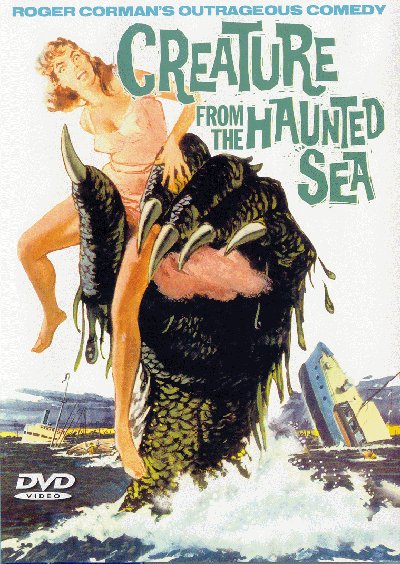
He will be best remembered for his trilogy of horror spoofs (Bucket of Blood (1959), Little Shop of Horrors (1960), and Creature from the Haunted Sea (1961)), all directed by Roger Corman. These hip screenplays were brilliant satires, not just of the horror genre. Bucket of Blood remains a dead-on portrayal of the Beat Generation, simultaneously giving it an elbow in the ribs, yet giving the milieu a far greater authenticity at which Hollywood failed miserably with such films as The Beat Generation, or The Subterraneans. Little Shop remains one of the greatest, most pitch black comedies ever made, with terrific, unique characters big and small. Griffith himself is the voice of Audrey Jr. the plant, and appears on camera as the wigged-out burglar ("Don't try to snow me Jim, 50,000 squares didn't come in here to look at some plant, they must have bought something.") Creature is an ingenious satire of nearly every movie ever made. In addition to the potato sack monster that calls attention to the artifice of horror films, there are nods to Bogart, spies, The Bay of Pigs, Dead End Kids, and even musicials (!), all while taking place mostly on a tugboat! In fact, at Word on the Street, when one person became aware I had free DVD's of Creature from the Haunted Sea in with "The Roger Corman Scrapbook", he chimed: "That is the corniest movie ever made!" It wasn't a put down-- it REALLY is an oddball film, just bursting with ideas.

These three films were really the only overtly spoofy films that Corman directed. In Beverly Gray's book on her former boss Mr. Corman, Roger Corman: An Unauthorized Biography of the Godfather of Indie Filmmaking, she hints at the idea that Corman otherwise preferred to make his films just serious action-adventures or straight fantasy pictures. I'm inclined to believe her, and yet am mystified that Mr. Corman didn't fully take advantage of Griffith's prose, despite the limited resources that he obviously had to contend with. Despite the success of all the films that will be mentioned here, there is a curious reservation on Corman's direction, often taking a conservative approach to the subversive ideas that went into Griffith's exploitation scripts. Beneath the sheen of Attack of the Crab Monsters (1957) is a strange Biblical parable and disturbing atomic message (that is actually more creepy than most atomic monster films of the period). Gunslinger (1956) is just below Johnny Guitar in being a western that implodes the conventions of the genre with two superb female roles. The cardboard muscleman epic Atlas (1961) is more interesting for the heavy-breathing sexual repression than the clumsy swordplay. Lest we forget, Mr. Griffith penned two more wildly inventive science fiction films (It Conquered the World (1956), Not of this Earth (1957)), Teenage Doll (1957) (which is possibly the most apocalyptic JD film made in the 1950's), and the terrific "Petrified Forest" retread with a hip beat (Rock All Night (1957), which became one of my great discoveries in assembling the Corman issue.

He also wrote later Corman hits like The Wild Angels (1966) and Death Race 2000 (1975), each with interesting social commentary, and then went behind the directors chair. First he realized his own screenplay Eat My Dust (1976), which is a gleefully subversive celebration of teen lawlessness that (surprisingly) goes unpunished. He also directed his own screenplay for Dr. Heckyl and Mr. Hype (1980) and Wizards of the Lost Kingdom II (1989). I am interested in finding his first work as writer-director Forbidden Island (1959) in the hopes that it is a forgotten gem. Ditto, Corman's film Naked Paradise, also written by Griffith, has fallen off the map. By some fleeting accounts, it purports to be an unusual melodrama. (Griffith re-wrote this film with a monster as Beast from the Haunted Cave.)

We all talk about people like Martin Scorsese, Peter Bogdanovich, Jack Nicholson and Bruce Dern, who all earned their stripes at Corman's veritable film school. Yet when you see much of their work done under his umbrella, one doesn't necessarily see the seeds of their future stardom. Griffith on the other hand was a singular talent. I am uncertain of how or why he didn't go on to make "A" pictures, but it is truly unique people like him that go a long way in justifying low budget drive-in genre films.

Jul 30, 2007

Death on the Beach... Remembering Ingmar Bergman


Above: "Death" and Max Von Sydow in The Seventh Seal.

Perhaps like many or most film-goers of my generation, my introduction to Ingmar Bergman was secondhand. Being born after the vital time period, one can only vicariously understand the impact an artist has made on his or her medium. This is why young journalists may not understand how revolutionary were the sounds of Charlie Parker, or the words of Allen Ginsberg. Similarly, it may be hard for younger viewers to understand the impact made in the 1950's by the prolific output of Swedish director Ingmar Bergman. And usually, young scholars have seen the works inspired by the master before the original objects of inspiration. For instance, I doubt I'm alone when I say that my true introduction to Ingmar Bergman was through Woody Allen. While I had seen Fanny and Alexander, which I admired more than liked, it wasn't until I saw Woody Allen's Interiors, where I truly began my education on this Swedish master of international cinema. The angst-ridden performances, characters' yearning for faith, and minimal set design were letter-perfect evocations of the works of Ingmar Bergman. Woody Allen also scored in capturing his mentor's brooding isolation- one truly doesn't think a world exists outside of the narrow lives of the tortured characters.

In the late 1950's, there was an explosion of world cinema appearing on North American screens- works which changed the language of film in structure, theme, and style. And for the next decade, one literally would receive a new arthouse masterpiece every few months, with work by the French New Wave, Kurosawa, Fellini and Satyajit Ray, to name only a few. And of the filmmakers who made such challenging work from abroad, only Jean-Luc Godard, Alain Resnais and Michelangelo Antonioni are left. Yet one could say that perhaps no work of international cinema mattered more than Ingmar Bergman. (It is for nothing that in the movie Diner, set in 1959, two characters go see The Seventh Seal.) In four years, eleven Bergman films premiered in America. Not only was he the most prolific, but every work, big or small seemed to be a new masterpiece... however not to everyone.

Even today, many viewers find such works as Wild Strawberries or The Seventh Seal confusing, and this is why the mention of his name is often to invite an accusation of "cine-snobbery" from his non-believers. But really, Ingmar Bergman's films are not incomprehensible. In fact, his stories and ideas are very simple, however what confounds many audiences is the figurative ways he tells his stories. He often chose to be allegorical or symbolic instead of realistic. For instance, in one scene of Hour of the Wolf, Liv Ullmann's suspicion of her husband's infidelity is realized by her dialogue she has with a woman... that represents part of her subconscious! In Bergman, reality and dreams, life and death, past and present all fold in on one another. Perhaps this is never so eloquently mirrored than in the finale of Wild Strawberries, when Victor Sjostrom sees his parents from seventy years prior, fishing at a river bank, and they wave back at him. But if this sounds heavy with symbolism, in truth his films are far less pretentious than, say, those of Antonioni. (The one time his use of figurative imagery did not work for me was The Silence (1963), the third of his "Faith" trilogy.)


Bergman's reputation was cemented just on the virtues of two films in the late 1950's. Wild Strawberries, features Swedish director Victor Sjostrom in a rare performance as a professor whose journey to the city becomes a journey through his past. This film is remembered for its opening dream sequence, where he sees himself in a coffin, and the famous image of a clock with no hands (later spoofed by Woody Allen in Stardust Memories). The Seventh Seal provides the famous scenario where a knight has a chess game with Death on the beach, with his life in the balance, and ends with the famous image of people dancing down a hill to another realm of existence. Yet there is so much more.


Above: Wild Strawberries

We must also remember the masterpieces of his early career such as Summer With Monika, a beautiful fable about a doomed love affair, and Sawdust and Tinsel, set in a traveling circus. And lest we forget, the delightful, magical Smiles of a Summer Night (later remade by Woody Who Else?) destroys preconceptions that all Bergman films are doom and gloom. Bergman continued making challenging fare well into the 1980's. The Virgin Spring (1960) ends with water spouting from the ground where previously laid the body of a dead girl. The personalities of two women intertwine with the well-remembered Persona (1967). In the 1970's, Roger Corman and his New World Pictures made Bergman more accessible to American audiences by distributing Cries and Whispers and Autumn Sonata at drive-ins, thereby shaking foreign cinema from the exclusionary claws of the arthouse. And within this body of work, Ingmar Bergman had a superb "stock company", with stellar performances by Max Von Sydow, Harriett Andersson, Liv Ullmann, Bibi Andersson, Ingrid Thulin, and Gunnar Bjornstrand... and the frequent hiring of the superb cameraman Sven Nykvist. Nykvist's bare cinematography captured the intense drama of Bergman's scenarios. And when the two men could no longer make movies in their preferred black and white, their colour films have a muted or monochromatic pallette which adds an interesting texture.

After making a famous retirement statement upon the completion of Fanny and Alexander (1983), Ingmar Bergman still occasionally directed films for television, developed screenplays, and worked in theatre. In the 1980's he also published the memoir The Magic Lantern, which is as full of atmosphere and dream-like structure as one of his films, and certainly one of the best autobiographical works written by any filmmaker.

Of all of Bergman's considerable body of work, my preferred period is the films made on the island of Faro in the late 1960's. These works (Hour of the Wolf, Shame, Passion of Anna) best capture the sense of isolation so common to his films, and succeed in treading that thin line between waking life and the irrationality of nightmares.

So unique and singular is Bergman's style that it has been imitated by admirers (not just Woody Allen, but Andrei Tarkovsky), and lampooned in SCTV and Anthony Lover's superb short film The Dove (De Duva). Shortly after I began discovering Bergman's films such as Wild Strawberries, The Virgin Spring and Summer With Monika, I wrote a little Bergman spoof for my high school English class in which I play checkers on the beach with the ghost of Rod Serling. The teacher loved it, although most students wouldn't get the reference, since Bergman didn't play small town Ontario. Writing this passage, I am reminded of how many years have passed since I've watched any of his films, since most of my viewing time presently is spent researching for articles in progress. Yet, for this film enthusiast, the style of Ingmar Bergman had a tremendous impact, and expanded much of how I look at cinema. I see myself in my old living room 20 years ago, when I was seriously educating myself on films, and he's waving back at me.

Below: The famous ending of The Seventh Seal.

Apr 20, 2007

Beatnik Discoveries


Thursday March 29 was kind of a double-whammy... not only did we kick off with the first screening of the new year, we also released the latest ESR extravaganza, the "Discoveries" issue. This was perhaps a little too much for one night, I know- it was a job in itself getting stuff together for the screening, but since my writing has been dormant for a long time (especially on this blog, so I'm reminded), I'm glad I kicked myself in the rear end to get the new issue done.

At first, I was planning for the new year's screening to begin with a Jack Palance film festival, as the iconic movie bad guy and trash film regular had passed away in November 2006. And as such, I had planned to do the screening in late January while his passing still would have been comparatively fresh in people's minds. Alas, January turned into February, and the weather was still bitter cold. For a little venue like mine, the last thing I needed was giving Torontonians another excuse not to come out, such as with the weather. But anyhow, late February, I decided that March was late enough to start screenings again, and then suddenly came up with the notion to do a beatnik-themed night.

The first hour of the program was a collection of clips from such things as The Rebel Set, Bucket of Blood, the "Petticoat Junction" TV show, Night Tide, and other jazz-poetry related clips from films of the time, along with the ten-minute documentary Greenwich Village Sunday narrated by Jean Shepherd, and Ron Mann let us use the Allen Ginsberg segment from Poetry in Motion. That was the first half of the hour. When I cut all this stuff together, I was roaring in laughter, but much to my surprise, the audience response was polite at best. For the latter half of the hour, I had an episode of the old "Johnny Staccato" TV series, with John Cassavetes as a private eye looking for a missing beat poet (God help us). This was the piece that set the tone for the rest of the night. It teaches me once again that I can never predict the response of the audience. After a pause for the cause to fuel up on more caffeine (which I need about as much as I need more VHS tapes), we showed The Bloody Brood, with Peter Falk paying his dues as the leader of a bunch of existential thrill killers in a beatnik cafe. This gem went over very well, played even better with an audience than having only seen it on DVD, and capped the night off. I deliberately did not mention that it was shot in Toronto, leaving it a surprise for the very end, when the final shot proudly mentions it was shot in Toronto, Canada. That of course opened the floor for discussion, and further added to the mystique of this little flick, which was made by Julian Roffman, the man behind the 3D favourite The Mask.

Tonight was our best screening to date, thanks to the best crowd we've had with some familiar faces, and new people who had recently joined the meetup group. And I must also give a special thanks to David Faris, for his unbridled enthusiasm from the word "go" when I first mentioned the theme of this month's screening. It was he who designed the ad work you see in this post, and he made a point of helping distrubute hand bills wherever he went. And as always, my Susan gets my undying gratitude. Kudos to her for showing up in her beret. Oh yes! One interesting fellow even dressed up with a fake goatee and a red blazer! That in a way encapsulated the evening-- people really showed their enthusiasm and contributed to the festive-like atmosphere I always encourage at these shows.


In the preceding weeks I was also working on "Discoveries". This, along with "Independent Voices" (coming soon!) was one of the ESR issues that kept on getting pushed back further and further because the Roger Corman issue kept getting bigger. What would happen is, I would work on Corman until I was overloaded with all things Roger, and then divert my attention a bit to Discoveries or the other one until my head cleared enough to get back to Corman. Anyway, in these few months, these issues had sat around in varying stages of incompletion, and so I kicked myself in the rear end to finally get it done. Alas, "Discoveries".

While I've always lined the context of my articles in the past with personal or sometimes autobiographical references, no issue has been this personal. All of the pieces are dogged with some kind of self-reflection pertaining to memories, aging, the dramatically changing movie-going experience. The week leading up to the screening, I was existing on three hours sleep a night and way too much caffeine just to get it done. With all the projects I've got up my sleeve for the rest of 07, I didn't want this one wallowing around.

Did I mention caffeine? As if I already didn't have coffee coursing through my veins the whole week, well I made some espresso at the screening and pumped more down me. Waking up the next morning, I still felt the nectar in my blood, half-asleep but still somewhat energized, giddy from the fanastic evening, shaking from the experience of what one of ESR's nights are supposed to be like....


Now if only I had remembered to take some damn pictures that night...

Jul 19, 2006

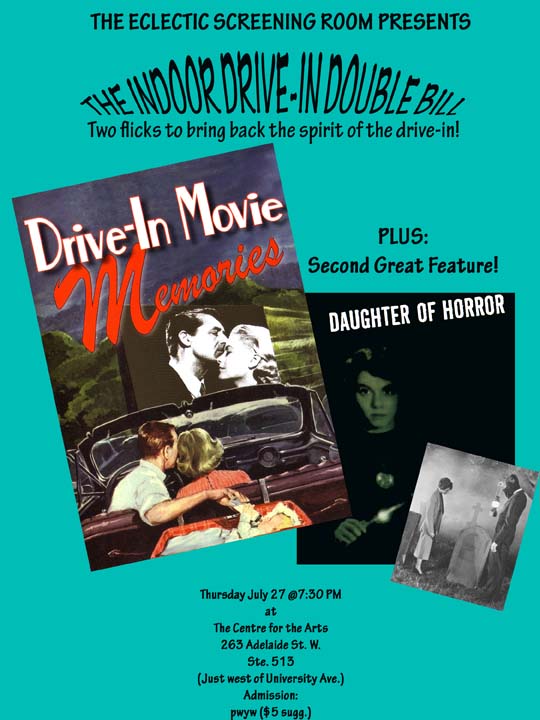
ESR Presents: The Indoor Drive-In


Well finally, after spending a long time thinking about it, I've started what I hope to be the monthly "theatrical" equivalent to ESR. The last Thursday of the month, you can now see The Eclectic Screening Room unspooling offbeat and interesting films at Centre for the Arts. Located at 263 Adelaide St. W., Suite 513, just east of John St., and about two blocks west of University, it is a cool little space, where the big studio room is used for the screening, and I have use of the lobby area as well to merchandise and sell refreshments.

The first screening, as you can see above, was the "indoor drive-in" festival, in which I first showed a lovely documentary DRIVE IN MOVIE MEMORIES, made in 2001. It is an hour-long feature giving an entertaining history of the drive-in from the 30's to present day, with lots of great nostalgia clips, and trailers, capturing the essence of the drive-in experience in its day. It also features interviews with Leonard Maltin, Beverly Garland, Sam Arkoff (I believe, filmed not long before he died), Celeste Yarnall and Robert Fuller, among others. Then I followed up with DAUGHTER OF HORROR, a mini-favourite of mine-- a completely mind-warping flick from 1955. It was first released in 1953 with the (far more accurate) title DEMENTIA-- with no onscreen dialogue, just music and ambient sounds on the audio. Then it was re-released with the title DAUGHTER OF HORROR, featuring narration by some guy named Ed McMahon!!! Although I prefer the earlier version, I screened the latter since it was public domain.

Our audience attendance was about a dozen customers. Not great, but I am rather glad I had a small crowd for the first screening. Since I was still working out the technical bugs right up till the first customers arrived, and still getting into the groove of running the gear (the switcher and what not), it just seemed best to do so with a group that was intimate enough which practically encouraged a "one on one" feeling. In that regard, the night almost felt like a friendly gathering as opposed to a clinical screening. Half of the audience was comprised of a meetup group entitled "We Don't Do Mainstream Film"-- somehow someone received notice of my screening at the last minute and posted it on the list. For that I am grateful. My friend Mike Ritz showed up, as did Will Sloan (who had contributed to the STILL in progress Roger Corman issue). Plus I was happy to see Chris Mitchell and Maria show up for the second film. The response to the films was polite, and it was a beginning.

As with any first-time screening at a venue, it was a trial by fire. But I learned a whole lot, and already have ways of making the next one better and smoother. End of August is Educational Film Night, or if you like, "ESR's Back To School Special". Hope to see you there.

Oct 12, 2005

Creature From The Haunted Sea (1961)


Since this is Thanksgiving in Canada, there should be some turkey in order, right? Well here at the screening room, I'm offering up this abomination from Roger Corman. And by the way, I use that term "abomination" with the utmost of respect.

If you know about the Corman filming process, they would first come up with the title, then the poster, then the movie. I'd like to know where along the line they decided that the monster in this movie was going to be some ridiculous potato sack thing with golf ball eyes. Good thing this film is intended to be a spoof. As such, for a grimy 500 dollar back alley movie, it's actually a lot of fun, with its hip narration, and plot of some gangsters looking for treasure in a lake where this high school pageant monster abides. You could call it a lighter cousin to LITTLE SHOP OF HORRORS, and as such, it's not at bad a way to kill an hour or so while waiting for the stuffing to get done in the oven.