Showing posts with label Screenings. Show all posts

Sep 24, 2020

[Thursday Nostalgia] Frankenstein Must Be Snowed In

In its day, Frankenstein On Campus (1970) gained some notoriety as the first film to be produced with assistance from the Canadian Film Development Corporation, and summarily was met with jeers that such a film was funded by taxpayers' money (and this was years before David Cronenberg's Shivers received greater controversy for its public funding). The film (re-titled Dr. Frankenstein On Campus) was picked up for American distribution on a drive-in double bill with Night Of The Witches, but has been seldom seen since, except for sporadic revival screenings, or late night viewings on Canadian television (when they still showed movies). To date, it has never had an official video release (although, as of this writing, Sinister Cinema offers it for sale, and a funky copy can be viewed on YouTube). 

Way back, in a time before YouTube really became a thing (that is, when singular uploads could only be ten minutes in maximum length), yours truly had planned to attend a revival screening of this "should-be cult classic", at the University of Toronto (where it was filmed). One March weekend, the U of T Film Festival was scheduled at Hart House. 

On the Thursday night (when our tale took place), the festival would commence with Horror 101, a series of horror-related student films, followed by a screening of Frankenstein On Campus, with a panel of participants from the film! Scheduled to attend were the film's director Gilbert W. Taylor, writer-producer Bill Marshall (later a founding member of TIFF), and Paul Hoffert (of the band Lighthouse, who appears in the film's party scenes), with Rodrigo Gudino of Rue Morgue magazine, and Adam Lopez of Toronto’s After Dark Film Festival. 

Alas, I didn't go, because.... and this is so Canadian... Hogtown was hit with a freak snowstorm! 

A blizzard, coupled with wind and thunder, descended upon the city, which created a big snarl of traffic. (Our city usually turns into a commuting nightmare with the first raindrop or snowflake, but this was something else!) At the time, I was still working downtown. Our office had closed early because of the weather. I was the last to leave, either because I was still debating going to the screening after work, or just waiting it out to see how the weather would change. I now forget exactly what prompted the decision not to attend. Perhaps it was the hour-long streetcar ride to the subway (a jaunt that normally took fifteen minutes), after which I was too dragged out to wait around for an event that may have been cancelled for all I knew. Or if I had decided to go home and head out later, that decision would have changed upon arrival in our neighbourhood, when I had to walk thigh deep in snow to the front door!

Instead, the evening was more low-key, spent in the kitchen with a couple of drinks, and watching Larry Buchanan's Curse of the Swamp Creature on the portable DVD player, while making pot roast. Still, to this day I wonder if that screening continued. This week, I finally got around to seeing the film (via a squiggly bootlegged copy), and was reminded of that crazy day all over again. Art and life were in sync: that day's frustration and ultimate surrender mirrored much of Canadian cinema in a nutshell. Our movies could be sub-titled "Cinema Of Frustration", as many narratives are characters falling short of their goals, and our feature film industry in general has a pervasive tone of self-deprecation. (This notion is deserving of its own future blog post.)

Frankenstein On Campus deserves better than its resignation to bootlegs or the occasional screening, because it is much more entertaining than its reputation would have you believe, with its hip (though not jokey) sense of humour, and inventive ideas. It was understandably picked up for American distribution (such as it was), because the film doesn't feel Canadian, if that makes any sense. It lacks the self-conscious tone of so many Canadian genre pictures of the time. If proper film elements still exist, a boutique company like Vinegar Syndrome should restore it for a DVD or Blu-ray release. After fifty years, it is time for this Frankenstein to rise again. 

While I regretted skipping that screening as soon as I set foot in the snow, I smile while thinking of those days, for it was a true Cinema Paradiso back then. For three years, Susan and I worked around the corner from each other. We were steps away from Cinecycle, Queen Video, Trash Palace, Centre For The Arts (where I hosted my own screenings at the time), to say nothing of numerous restaurants and taverns we'd frequent between gigs. By the end of the decade, we were both gone from this location. Our departure seemed synonymous with much of the area's re-development. Many of our favourite haunts (and "slop shops") would soon disappear as the landscape began to resemble something out of Blade Runner.

Oh yes, about the U of T Film Festival. The Friday night had three programs (student films, plus an initiative entitled UofTube, followed by a feature, Drop Box). On Saturday, Super 8 films were projected, with live accompaniment by Guh! (Oh, where was I then? Were we still snowed in?)

Mar 10, 2018

Eurofantasmo! #1


Since my last birthday had a zero in it, I decided to keep my mind occupied for the day instead of moping around in my bathrobe, drinking cheap sherry and watching reruns of "Flo". (Not that there's anything wrong with sitting around in your bathrobe, drinking cheap sherry and watching reruns of "Flo", if the spirit moves you.)

Therefore, on the big day, I did a couple of things that I hadn't done in years: I hosted a screening and printed a zine! One overcast Sunday afternoon, the very first issue of Eurofantasmo! made its official, though inconspicuous, debut at the screening.

Eurofantasmo! chronicles the rich history of Europe's genre cinema circa late 1950s to 1990; each issue tackles a different subgenre or topic. The debut issue focuses on superhero or super-criminal movies made in Italy during the 1960s. These twelve digest-sized pulse-pounding pages review eleven such films, including Danger Diabolik, both Kriminal films, Satanik, and both Superargo movies.

While still toiling away at the new, revamped ESR (which has already been pushed back twice), I had the idea to do this little zine. Consider it the side dish to the main course still in progress. This project nonetheless provides an outlet for my lifelong fascination with and exploration of European genre film (and I still feel I'm scratching the surface). I felt it was a necessary diversion to preparing the new ESR. It also proved to be a pleasant throwback to the old days: thinking about design, proofreading, stapling and collating.

And considering after three months, I have yet to receive any feedback on it, yep, it really is like the old days. (Granted, I'm behind in mailing out some copies to people who wanted a mag but couldn't attend the screening.) I still have some if you're interested! The next issue will likely go to print next month.

Oh, and what was the screening? I showed the Stephen Boyd-Sylva Koscina caper film, The Manipulator. Whatever I can do to spread the word on this quirky delight.


Aug 18, 2015

Early Monthly Segments Presents: Keith Lock + Oliver Bancroft (in person!)


Hard to believe that next Monday, Early Monthly Segments will be presenting their 75th show! Amazing. Hats off to programmers Scott Berry, Chris Kennedy and Kate MacKay, who present avant-garde cinema once a month at the Gladstone Art Bar in Toronto. For a small admission price, you can enjoy the history of independent-experimental film the way it should be seen: projected on 16mm with an audience.

Nov 6, 2013

That Night At Cinema Subterrain


Last night, for the first time in years, I re-watched this little video I shot and edited depicting the Saturday night in November of 2005 when cinema showman supreme Dion Conflict presented his Hunkajunk Vol. 4 screening at Skot Deeming's Cinema Subterrain in London, Ontario. Skot, longtime friend and sometime ESR contributor, is a twenty-year veteran of the independent scene, who has dabbled in zines, moviemaking, film distribution, and VJ-ing. In 2003, he had moved from Toronto to take a job in his native London. Within a year, never one to rest on his laurels for long, Skot began the monthly Cinema Subterrain screenings in the city's L.A. Mood Underground, the basement of the L.A. Mood comic and game shop. (The space was also being used for role-playing games and poetry readings.)

Dion Conflict has programmed cult and ephemeral cinema prints from his own collection since the 1990s. In the early 2000s, he was doing bimonthly "Conflict Archive" screenings at the Royal Cinema on College St., and publishing a zine Konflikt in the Kino in concordance with those shows. During this time, he also revived the Hunkajunk series that he had done way back when at the Rivoli. True to the name, these programs were a potpourri of educational shorts, training films, movie trailers, TV commercials and what have you: all in all, entertaining decoupages of past pop culture artifacts. Skot happened to be in Toronto on the same weekend that Dion premiered Hunkajunk 4 at the Royal in December of 2004. We attended, and in our herbal euphoria giggled and heckled through the proceedings, providing Dion the audience participation that he wished for. At that screening, Skot had decided to bring Dion to London to present Hunkajunk at Cinema Subterrain. The two men finally met after several months of my trying to get them together in the same room (it was an ongoing joke how these two guys kept "just missing" one another at various events). A deal was made, and nearly one year after it had premiered (in the interim, showing in North Carolina and Finland), Hunkajunk unspooled in London, Ontario, one crisp autumn evening.

On this same weekend in 2005, I had finally fulfilled a promise to visit Skot in London and check out his screening series. Because I had spent half the previous night in the collision centre filling out accident reports (a truck had rear-ended my rental car within fifteen minutes of driving it off the lot), and because of a last-minute emergency at work which forced me to cut short my visit and return at the crack of dawn on Sunday morning, my nerves were so frazzled, that I couldn't then fully absorb this experience. Somehow, despite all this fuss, I had the last-minute foresight to bring a video camera to record the event, for which I later became very grateful. Upon reviewing the footage, I vicariously relived the moment, and appreciated its true worth.

Even though the camerawork wasn't all that great (not helped by my anxious mental state and the absence of any game plan), I felt there was enough there to cut together a little movie. The nine-minute film comprises of several sequences: Skot and his friend A.W. setting up the show; Dion doing his introduction; brief clips of what is being shown (with the necessary audience guffaws on the soundtrack); and a wrap-up of people just hanging out afterwards with Dion selling his wares. This whole project was just a toss-off that would only ever be seen by the people involved, but warts and all, I'm proud of the little thing. The grainy Hi-8 look and hand-held work indirectly added an authenticity to it.

After seeing it again for the first time in seven years, I realized that perhaps it is time to revisit the footage, clean up the audio, and put together an extended cut. The crux of the movie is obviously Skot and Dion, but there is much more going on under the surface of this little epic that could be fleshed out. After absorbing the central story and the technical stuff in the first view, I re-watched it several more times last night for the ambience, and to remind myself of what more I had shot that could be added in.

This movie has the potential to be more about than what the two guys are putting onscreen: it could include more footage discussing the L.A. Underground space and how it is used, the communal effort by many people who helped behind the scenes, and especially the interesting regulars who would come to support this venue. It preserves a little moment that most of the people involved have likely forgotten. It is a document about a space that every month or two became a little piece of culture where people could celebrate some unique programming and hang out with other individuals looking for something out of the mainstream. It is also about a piece of time that is truly dead: Skot and Dion have moved on to other things, and many of the people involved have parted ways. Cinema Subterrain would cease the following spring. (The Hunkajunk screening was the first night that Skot's shows went bimonthly, until he finished in May of 2006.) And sadly, it is also a representative look at many similar micro-cinemas that are fast disappearing in the onslaught of urban gentrification.


Over the winter, I'll be reviewing and recapturing this footage to work on this extended version, and attempt to realize what more this little movie has the potential to stand for.  

Below is a sampling of shows that were put on by Cinema Subterrain. (If you have a micro-cinema like this in whatever city you're in, get out and support it, because you'll miss it when it's gone!)


These two images represent the "audience choice" screenings, where patrons voted beforehand which of the two programs they wished to see that night. Sadly, Cinema Subterrain ended before this show materialized, but Horror Mexicano was winning.


Sep 28, 2012

The Toronto Film Noir Syndicate


...and now that Word on the Street has past, it's time to continue to the next project I've been involved with for the past couple of months. Yours truly has joined Shirley Hughes and David Faris in The Toronto Film Noir Syndicate. This collective will be showing classic film noir several times throughout the year.

Tomorrow, Saturday Sept. 29 is our inaugural screening. This is the first of our fundraiser screening, in which we hope to raise funds and awareness for our plan to hold these events in the future at a theatrical venue.  Tomorrow's event will be held at the Dominion on Queen, 500 Queen St. #E.  The show begins at 8 PM-- admission is five dollars.

For further details, visit the syndicate's website by clicking here.

You can also like the Toronto Film Noir Syndicate on Facebook.

Aug 5, 2012

Who Is Bozo Texino? (2006)


“I guess you could say there’s a mystery to it; maybe you want it to be a mystery.”

The best film I saw in all of 2006 was Who Is Bozo Texino, a mesmerizing 55-minute black-and-white documentary by Bill Daniel.  The novel premise, about the search for the identity of a railroad graffiti artist, would already make for an intriguing film, but this piece is also a stunning decoupage of sight and sound- such a dense montage of striking visual compositions, and impressionistic voiceover. It is such a feast of a movie that one can scarcely believe it runs less than an hour.

Viewing Bozo Texino is to get the feeling of entering a secret society, and in fact, even attending the screening for it at Cinecyle in the fall of 2006 gave it that impression.  I had only learned about the event by one posting on a website, but the rest of the clientele however already seemed to be “in the know”.  The sense of being inaugurated into a subterranean culture is perhaps the perfect kind of inertia needed to view this film, which is in pursuit of an elusive subject.  (This screening opened with Bill Daniel’s two-minute short subject, The Underground Square Dance Association- a hilarious piece about another subterranean culture, which set the tone.)


The concept of people “riding the rails”, hobos hopping a freight train to a new frontier, harkens images of the Depression Era, yet, as one narrator suggests, the tradition dates back to Jack London era, the 1890’s. This custom of hopping on a freight train has outlaw romanticism, with the hobo (not a “bum”, but a “hobo”) as the classical renegade figure, defying responsibility and authority by charting their own destination on the rails. And to think that this tradition continues today is perhaps surprising, but that is also part of the film’s appeal. Although a lot of the people who speak on film are leathery, weather-beaten old men, one gets the impression that this tradition will continue, with the brief shots of young hippies running to catch a boxcar.  Very early in the film, we understand why this romantic notion continues in today’s society, with a breathtaking shot of a hobo in a boxcar looking at a mountain range.  It prefaces one man’s later observation: “To be absent from society is to be on a higher plane.”

During the making of this 16-year project, Bill Daniel has also edited for Craig Baldwin’s equally dense, found-footage collages.  That pursuit has served him well here, as it is a rhythm-perfect piece of film that moves like music, with crescendos and well-placed diminuendos.  Seeing this flurry of images and sounds in such a fragmented frenzy, one gets the whirlwind feeling of teetering from a locomotive.  And in moments when the film slows to a Zen calm  (where a single shot will play for a couple of minutes), it gives one the impression of a good rest at the end of a journey.


What is more, this remarkable film implodes the conventions of documentary, with its multitude of narrative viewpoints.  Its huge ensemble of anonymous voices is presented in as much a dizzying, disorienting fashion as the visuals.  Despite that we see some railroad riders onscreen in several scenes, they still remain as strangers to us: as phantom-like as the plethora of signatures and drawings on the trains that we see throughout.  A conventional A&E documentary would probably have started right off the bat with some exposition on Bozo Texino, yet we first see a (fleeting) shot of Texino’s drawing at the ninth minute, and only at the eighteenth (nearly one third of the film has already elapsed) does someone first mention his name.  Since this hour-long film is a condensation of a lifetime on the tracks, it makes sense that we only gradually learn of the central character, just as someone gradually would hear these stories as legends after time spent riding on the trains.

While perhaps documentary-like in its structure of talking heads, narration and candid shots of people catching rides on trains, this film more succeeds in giving the viewer a synthesis of what it is like to hop a freight train to parts unknown.  Its disorienting approach also compliments the fuzzy narrative, as this subculture is full of people who assume others’ identities.  John Easley, for instance, has adopted the signature of an older man named Coltrane (whose trademark is an Old West scout with long hair and a huge moustache).  As such, we hear conflicting opinions as to who is really signing the trains as Bozo Texino.  Unlike the case of Citizen Kane, perhaps we really don’t want to know the revelation of this “Rosebud”.

Because this subculture is so steeped in legend and lore, solving this puzzle perhaps robs it of its mystical quality.  This journey to uncovering Texino’s identity is another metaphor for the train ride—the destination matters less than the road trip.  On screen and on paper, Who Is Bozo Texino gives us a representation of a long exhilarating ride, with its blurry narrative and blinding editing, as a lifetime of memory and folklore is distilled into one hour.  Even more, each of these fleeting images is a miniature work of art in itself.  With the meticulous attention to frame composition and rich contrasts, Bill Daniel ably validates this vanguard lifestyle as an overwhelming experience.

It is perhaps over-simplifying this bohemian existence by romanticizing its freedom from the clutches of modern society, but how this film was being shown to the audience adds to that image.  Avoiding the usual trappings (literally and figuratively) of the film festival circuit, Bill Daniel would travel the continent in his van to show the film: fitting for the “wandering spirit nature” of its subject.  My seeing it in a cold, wooden screening facility (perhaps not unlike a boxcar itself) one October night further added to the visceral experience of this truly remarkable movie.

While you should see Who Is Bozo Texino on a big screen somewhere, somehow… you can purchase DVD’s of the film at www.billdaniel.net.

(originally published in ESR #18)


May 7, 2012

Did You Ever Hear The Words, Blue Sunshine?


Cinema closures are an unfortunate trend these days. Whether it’s a multiplex or a micro-cinema that caters to marginal tastes, it appears that the future of theatrical venues is in jeopardy, as they fall prey to lower attendance, higher operating costs and the redevelopment machine. As Toronto reels from the sudden news that the Festival darling The Cumberland shuttered its doors for good this weekend, cult film fans in Montreal are counting down the days before Blue Sunshine closes.

Founded in 2010 by programmers Kier-La Janisse and David Bertrand (and named after one of my favourite cult movies), Montreal's Psychotronic Film Centre / Home of the Miskatonic Institute, is a dream destination for anyone whose interest in cinema journeys beyond mainstream releases into more outré territory: horror films, music documentaries, vintage cult favourites and a generous helping of Canadian genre films are just some of the tantalizing goodies offered in Blue Sunshine’s schedule.

Within the past 24 months, Billy Jack, Sugar Hill, Strange Shadows in an Empty Room, Melody, The Alien Factor, Lemon Popsicle, Don't Be Afraid of the Dark, and Kriminal, have been among the titles presented at this cinema, often in 16mm. Their tastes shame even the cult film programming in beautiful (cough!) downtown Toronto. In addition to the psychotronic movies being screened, their self-styled Miskatonic Institute would also feature lectures and workshops about cinema to ensure that these works remained alive for future generations.

My fellow programmers at Trash Palace (whose own days are numbered, by the way) had a strong bond with the Montreal micro-cinema, as they would often journey to Quebec to present their own selections of films at Blue Sunshine. My one and only encounter with the venue was last fall, when I was in the city for Expozine. Coincidentally, my friend and TP cohort Jonathan Culp was the guest programmer that same weekend, hosting a series of films by and about Lotte Reiniger. Upon setting foot inside the theatre, I had become another convert.

This third-floor cinema is truly wonderful, evoking both nostalgia and modernity. The projection room has the facade of a ticket booth, emanating its beams into a clean, comfortable gallery space. In addition, the facility has a walk-up kitchen counter for refreshments, offers choice literature and DVDs for sale, and is refreshingly free of poser attitude. If pressed to compare it to anything in Toronto, I could only think of The Nostalgic Cinema, which had a similarly homey, friendly feel, and seemed to have an ulterior motive of being a resource centre to its patrons.

Indeed, upon perusal of Blue Sunshine’s monthly schedules, it is apparent that their choice programming comes from the heart, and not from an accounting ledger. In other words, theatre programmers who do screen cult movies usually are concerned with the bottom line, and as a result, often rely upon the most familiar titles to ensure ticket sales. It appears that Blue Sunshine's maxim is showing such marginal fare… simply because it must be shown! Tell me, where else are you going to see Black Rodeo, Youth Runs Wild or Gonks Go Beat... in a theatre?

It is with a heavy heart to announce that Blue Sunshine is shutting its doors for good, as its lease is expiring, and the cost-prohibitive measures of continuing even a small venue as this in downtown Montreal outweigh the cultural advantages. The cinema offers up its final week of programming this week with Ladies and Gentlemen: Mr. Leonard Cohen (May 10), Battle Beyond the Stars (May 11) and This Is Spinal Tap (May 12). The following weekend is their closing party. As with anything else Blue Sunshine has offered up in the past two years, my response is: “If I lived in Montreal, I know where I would be!”

Please visit their website.

Sep 13, 2009

Remembering The Nostalgic Cinema


Although the date was actually the tenth, it was actually this second Sunday in September of 1989 that I first went to The Nostalgic Cinema. For years I had read their movie listings in The Toronto Star every Friday when I would peruse the “Entertainment” section for the new movie reviews. In my long-range plan to flee my small town roots for the big city, it had always been my ambition to check out this place once I had planted roots in Toronto.

I had already moved into residence at York a week prior, and classes were to officially begin the following day. For whatever reason, I went back to the town of my birth for the Friday and Saturday nights. However, Sunday morning I was on the 403 back to Toronto, filled with an incredible sense of euphoria. I’ve already rhapsodized elsewhere in these pages about the life-changing year I had upon returning to high school in 1988-89, and don’t want to repeat myself here. However, I’m listening to Laura Nyro as I write this, so forgive any melancholia I do inject into this post. Yes, I had traveled a rewarding but laborious path to get into film school, and the summer of 1989 had its tribulations due to the fact that I had to cut loose all or most of the new life I had made- a fact I never truly got over for some time.


But despite the bittersweet emotions that pervaded the times, that Sunday morning drive to Toronto saw me filled suddenly with vigour, and excitement for my new chapter in life. On this day, I decided to give a little present to myself by finally checking out The Nostalgic Cinema in person, rather than just living vicariously through their Friday listings. Three days earlier, I had read that they were showing five films on the Sunday, and decided that this would be a better introduction than any. (I should add, this was back in the days when I could see more than one or two films in one day without any guilt or thoughts that I should be doing something else.)

I arrived in the big city at lunch-time, just enough to drop off whatever stuff I had brought up to residence and to make it back down to the first film at The Nostalgic. It was a tiny cinema in the second floor of the Kingsway Cinema at Bloor and Royal York, which had its own entrance to the left of the building. I had bought a membership card, which still saved me money from simply getting regular admission prices for the five films.

The afternoon opened with The Penalty, a 1920 crime melodrama starring Lon Chaney Sr. without legs, followed by a nifty, forgotten supernatural crime thriller, Hole In The Wall (1929), starring pre-Little Caesar Edward G. Robinson. Then came the 1929 version of Mysterious Island, which contains scenes silent and with sound. Apparently unseen in Toronto for decades, it was great fun (and the ancestor of Close Encounters and The Abyss). Then the evening came with Murders In The Zoo and Dr. X, both with Lionel Atwill.

In between screenings, you could mosey from the 100-seat screening room into the library to pore over vintage literature on cinema (although with the brevity of breaks, I don’t know how prodigiously one could peruse any of it). Or, anyone in for the long haul might have had just enough time to get a microwaved sub from Becker's, or to go grab a cigarette. A cute little brunette in a fedora brought up some soda and popcorn for sale from The Kingsway (at prices curiously lower than what they were downstairs). A guy in a LOUD plaid suit-jacket (I swear he was there every time I was) looked over the old lobby cards. Being in this place felt like being in a scene torn from a Woody Allen screenplay- it was its own world separated from the outside. In this dimly lit little dwelling, the literature of the 20th century was being upheld.

I belonged here. This was not a movie crowd of cell-phone wagging, bottled-water popping posers who were playing their favourite variation on cine-snobbery. Seldom have I seen a more eclectic crowd of moviegoers than during any night here: real people, strangers all, united by a shared love of a piece of celluloid from the past.

One must remember that this was in the day when there were still glaring absences of classic film titles on video, and much of what The Nostalgic offered wasn’t readily available to see at home on VHS or the late show. Each eight-week schedule was a treasure trove of little gems from cinema’s golden age: Universal horror films, vehicles with your favourite comedy teams, silent classics you could only read about, film noir, westerns, romance, you name it. They used to show two films a night, and also run a Sunday afternoon program. (On Thursday nights you could see the second film free.)

Sadly, after too many moves, I had lost whatever schedules I had acquired from them (a four-page flyer on newsprint, with a screening grid on one page, and individual write-ups in the center spread), and they were always a joy to read. (For instance, in a capsule reviewer the editor would elaborate upon a bit player who makes a token appearance in that certain film.)

After that night’s films ended, I chatted briefly with Dave Eustace, the owner and projectionist, who also recommended the Tuesday night film, Beggars of Life, as I had enquired about it (prior to this, I was only able to read about Louise Brooks). And true enough, I trucked down there that night to see it (to date, it remains my favourite of her films, and my bias is likely influenced by having seen it in a cinema).

For the rest of the school year, I would make my treks out to the west end to see films: Laurel and Hardy movies, The Old Dark House (on Halloween night!), Buster Keaton and Harry Langdon silents, and Freaks, just to name a few. Typically, I would misplace my dog-eared membership card, yet thankfully they would remember me as enough of a regular to let me in with a member’s admission price. And as far as I can remember, the magical evenings would end with a vintage slide saying “Good night” being projected, as big band music filled the theater. My final screening at The Nostalgic was in the spring of 1990- the Lon Chaney version of The Hunchback of Notre Dame.

A typical night at The Nostalgic was usually one of joy. This little cinema was a little time capsule from which one could sequester themselves from the modern world for a couple of hours to revel in a piece of history that one could share with surrogate companions in a screening room. After being out of the city for a few years, I moved back to Toronto and started attending the usual repertory cinemas again, only to find out that The Nostalgic had closed in that spring of 1994. Sadly, its owner, Dave Eustace, had to turn off the projector permanently due to health reasons. (He passed away in 2003) For years after, when I came out from seeing a movie at The Kingsway cinema, I would sit in the Second Cup on the corner and reminisce about the little cinema above it.

One time during the intermission of a double bill at The Kingsway, I went upstairs to the washroom (which was shared by Nostalgic) and sauntered up to the doorway that led to the former palace of wisdom. Peering through the window, I could see across the hall into a former darkened room which now had glaring light resonating from Bloor Street. The walls were stripped of memorabilia and the projection system was half-destroyed. On the window in the entrance from Bloor St., something rather eerily remained for a few years. It was a laminated paper with a clock design printed on it, with two plastic hands that one manipulated to show a designated time. The writing above the clock said, “The next screening will be at”

A rather fitting last shot, really.

Seeing that clock face there years later invited the idea that maybe they would be back some day, but as we know, sequels only happen in the movies, and even then, they're haphazard at best in reliving a magic moment. Perhaps The Nostalgic Story is emblematic of life in the past 20 years, as within those two decades I've experienced death, disappointment, regrets... all typical aspects of the life cycle mind you, but of an epic story that doesn't necessary end on a crescendo like the larger-than-life characters we flock to see projected 24 times a second.

But more to the point, the Websters definition of nostalgia is a longing for the past, and that too plays into my life, as I've spent many of my years foolishly trying to recreate past glories until I was finally able to accept that the past is gone and move on. And perhaps because of that magic number "20 years", I've been reminiscing more about the glory days of late, even going as far as tracking down former school chums, but to what avail? What am I searching for, exactly? But The Nostalgic wasn't so much longing, as preserving and celebrating pieces of our past. It too, has now became part of our collective past. Like the films it celebrated every night, The Nostalgic Cinema is a piece of culture that would have an even greater uphill battle trying to sustain itself in today's climate (for reasons better left to another post), but rather than lament that sorry reality, we can rejoice in what it stood for. Isn't that why we see old movies, anyway?


Sep 27, 2008

ESR presented... Dogpound Shuffle


Way back in the eighties, I encountered a film title called Dogpound Shuffle while browsing through the TV Guide at 2 AM, was intrigued by its quirky synopsis, and switched over to Channel 11. And I was hooked. 20 years later, I had found a used VHS copy of the film (which had fleetingly been released by Key Video) and was delighted to see that it still worked its charms. (I had mentioned this re-discovery in one of my first ever blog postings.) Last year, I had the good fortune of finding a 16mm print, and had waited for a good opportunity to show it.

As of this writing, Dogpound Shuffle would be the fourth film I had shown at Trash Palace (with the exception of contributing to the educational film festival in the summer), and this was the film I was most looking forward to show. It didn't matter to me if only two people showed up-- to me, this film is an object of beauty, and I just wanted it to be seen. This screening was truly done out of love-- any prospect of making money was secondary to me.

This little fable, shot in Vancouver in the mid-1970's, features Ron Moody (from Oliver!) as a hobo (and former tap dancer) whose beloved dog Spot is captured by the dog catcher. Along comes David Soul (pre-"Starsky and Hutch") as a tramp who can play a mean tune on the harmonica (that is, when he doesn't have something to eat in his hand), and so the two former a music-and-dance act to raise the thirty bucks to get the dog out of the pound!

To my delight, this was one of the most satisfying screenings I've done anywhere. The audience ate the film up-- they laughed at all the right places, and were also moved at all the proper spots. And you just had to be there, to witness a bunch of forty-year-old tattooed males go "Awwww" when Spot does his little dance. What a night-- at the end, I was refreshed as though I drank from the holy mountain. I know my deepest thanks to Stacey and Dan, not just for inviting me into the Trash Palace family, but for allowing me to take a chance and show a film like this.

Jun 23, 2008

Grinding at the Fox... or, I managed to stay up till 10 AM watching films...


On Saturday night, or Sunday morning, whichever you prefer to call it, Toronto programmer Dion Conflict fulfilled his long-held ambition to have an all-night film show, entitled "Shock and Awe", in tribute to the Grindhouse days of yore, held, ironically, at The Fox Cinema, in the heart of The Beaches, where not much else goes on in this sleepy yuppie retreat all year long except for The Beaches Jazz Festival (which is derided by most of its locals except the business owners). This location is certainly a long way from the fabled Times Square grindhouses, or even our own Yonge Street strip, which in its heyday housed the Rio, whose all-night runs of sleaze films influenced Dion's own desire to give Toronto another taste of such long-extinct action. But The Fox itself is representative of how times have changed, and so it is doubly ironic and fitting that we received doses of cinematic sex and violence in such a family-oriented neighbourhood.

Those who read Bill Landis and Michelle Clifford's quasi-romantic reportage of the debauchery in the Times Square theatres as collected in their book Sleazoid Express will be informed that no rough trade, clouds of marijuana, drinking or police raids were found this night, and the only cans rolling in the aisles were Red Bull. I went to the bathroom a lot, but that was because I was drinking so much coffee. The audience was well-behaved, the decor was modern, and my shoes didn't stick to the floor. Perhaps one should be grateful for the passage of time, after all. Thus, all of the ingredients of the iconic grindhouses were found on the screen, not below it, and that suits me fine. Seeing these half-dozen artifacts from less politically correct times was enough of a history lesson on how much cinematic form and content has changed. But perhaps more importantly, seeing these films on a big screen with a responsive audience added another dimension even to the movies on the bill that I had previously seen. Getting the chance to see any non-current film on a big screen is a valuable cultural lesson, and also a fragile gift that we must continue to appreciate, lest it go away tomorrow.

For those not among the eighty troopers who watched films from 11:30 AM to 10 PM, here's what you missed:


The Boogeyman (1980): I've always considered director, former Fassbinder protege and current direct-to-video hack Ulli Lommel to be a two-trick pony. This and Brainwaves were the only two good films he ever made, in my opinion. The event wisely began with this well-remembered horror film-- the perfect appetizer to get everyone wound up for the six-course meal. All of its weird violence kept the audience going, and after having seen it a couple of times on video, its mood still holds up quite well (also love the use of primary colours in the last third). But the viewers' snickering at the non-horror scenes only confirmed my belief that Lommel can't direct actors to save his life. But isn't wooden acting also part of the menu for a grindhouse festival? Plus, I love Tim Krog's electronic score-- soundtrack album, anyone?

Perhaps the surprise hit of the evening was Matt Cimber's apocalyptic The Black Six (1976), which has the giggly novelty of having six football players filling the title contingent... and not one of them is Jim Brown or Fred Williamson. To be sure, the audience had a blast watching these guys kick some cracker butt, as well as digging the hip dialogue. One of the six discovers that his brother was kicked by some white trash bikers, and his friends help him get revenge. The plot is operable at best-- as it takes about as much time for him to find the culprits as it does to get a haircut. Instead, the narrative is more thought-provoking for its politics evoking everything from Angela Davis to Uncle Tom, showing the complexity of white-black race relations, and its climax lets no-one off the hook.

At best, Naughty New Orleans (1954) is a valuable filmed document of exotic dancers, musicians and comedians from the period-- and I use the term "filmed document" very loosely, as there is little that is cinematic in this rigid affair, replete with day-for-night shots, the same bizarre reaction shots of toothless patrons and spectators who inexplicably bring their wives along to see the strippers, and a nailed-down camera a la Warhol that records dancing moves that wouldn't pass amateur night at The Brass Rail. Interspersed with the acts is the emcee whose tableau of real groaner jokes are at least better than the average homegrown show on The Comedy Network. In the same tradition of a Sam Katzman musical, the plot is merely an excuse to string along the acts. Yell "yeah right" with me unison as I reveal the storyline about a jetsetter who goes out book-shopping in N'awlins, comes across this burlesque club, and is delightfully surprised to see that his girlfriend isn't a secretary after all. The burning question of what kind of book store he'd find at midnight remains unanswered, but I'll bet it would be like that smut shop on Yonge St. that mercifully closed last year.

And now, for a double-shot of 70's hedonism. Rene Cardona Jr's Tintorera (1977)is one of the many "Jaws" rip-offs of the period, but to say this is a shark movie is to call Porky's a stinging satire of our educational system. Mostly, this is a sex romp, as a three-way act is rudely interrupted by a pissed-off tiger shark. Like other Cardona films (Survive; Guyana- Cult of the Damned) this is completely shameless. At least it delivers more sex than most non-porn films of the era ever dared. It is an ugly movie about people with equally ugly morals-- when the shark shows up one almost can read this as a biblical metaphor about the fornicators being punished for their sins, but when the danger passes, people go right back to the pelvic push. This just wouldn't get out of the gate today with its likely authentic scenes of clubbing sharks-- if there was anyone from the Humaine Association on this set, they were likely being serviced while the crew was out filming. It is a fascinating piece of misanthropy.

Danish Pastries (1973) on the other hand, seems like a frolic. This featherweight cheerfulness shows what happens when an aphrodisiac gets mixed up in the water supply, and the students of an all-girls school have their way with all the cartoon-like male goons in the village. This Euro-trash mixes sex with typically overcranked and overdone slapstick, centering on the switching of suitcases... the other containing some potion which would have controlled the passions of the young ladies during the predicted passing of Venus, to prevent another exercise in debauchery that occurred in seventeen-hundred... and sixty-nine. But what fun would that have been?? This silly hardcore fluff was sinfully entertaining to watch on a Sunday morning.

Finally, with the sun already high in the sky, we had the headliner act, Peter Jackson's Dead Alive (1992), presented in its seldom-seen uncut version. While surely it is one of the bloodiest films you'll see in a month of Sundays, all of the carnage is perversely cheerful. Jackson instead delivers a non-stop roller coaster ride in the spirit of Sam Raimi's Evil Dead films. A hapless schmoe's domineering mother becomes a flesh-eating ghoul after a bite by a rat monkey, and soon more of the undead begin piling up in his basement. This crazed film may not be everyone's cup of tea, but it is surely not boring. It is a Grand Guignol exercise, with every nuance overplayed to operatic proportions-- almost every shot swoops, zooms and tilts. At the heart of it all is a pitch-black Oedipal satire unlike any other on the screen, where the poor guy can't shake free of his mother, even when she's a shambling, rotting corpse. Dead Alive was the perfect jolt in the veins after such a trip through various aspects of grindhouse culture. While this film was made well after most of the archetypal grindhouses had been plowed over in favour of Starbucks and condos, it surely keeps in the gleefully nasty spirit that encompasses the rest.

As it stands, "Shock and Awe" was a fun night alone for its marathon journey through the history of exploitation. But it just wouldn't be a Dion screening without his bizarre prizes -which were drawn every intermission- and blue light specials (finally-- a copy of Sun Bunnies). Plus, the Fox also served up burritos, pizza and -haha- Danish pastries, making this a night full of goodies. It could hardly be called just a night at the movies-- it was a piece of history, and an event unto itself. Such a good time was had by all that they're already talking about doing another grindhouse festival in the fall. Bring it on MacDuff.... and keep those blue light specials coming....

Oct 21, 2007

TV Party


"TV Party" was a cable access show, running in New York, from 1978 to 1982, hosted by writer Glenn O'Brien, and was known for the punk-new wave musicians, as well as artists who were frequent guests, participating in the screen mayhem (Blondie's Chris Stein was often a co-host). The show also pushed the envelope in form and content, with irreverent onscreen antics, all while capturing the whole scruffy "Do It Yourself" aesthetic that permeated the music and underground film scenes in the Big Apple at the time. Seen today, its lo-fi technology may be otherworldly to those weaned on the antiseptic blandness of "Reality TV". Yet the rough nature of the show complimented the excitement of the era, and the temperature of the times.

I first encountered this phenomenon called "TV Party" last Boxing Day, in the semi-annual blowout sale at Vortex, I happened upon three singular DVD's, each with one episode of "TV Party". Upon scanning the synopses on the backs of the bus, it piqued my curiosity enough to grab these discs. It sounded weird, avant-garde and off-the-wall... definitely up my alley. (And also, curiously, it is during the winter that I specially hunger for avant-garde things more than any other during the year.) Well, based on the evidence of one singular episode of "TV Party", entitled "The Time and Makeup Show", I had ended up with more than I bargained for. This particular episode was so minimalist-- the camera drones along almost as atonally as the noise music that is played throughout the show, that it just seemed to take on a life all its own. (Think good Warhol.) So entranced was I with this video, that I put the show on repeat, letting it play all night, and continuing on when I woke up in the morning. It just became this organic kind of wallpaper that I would gaze upon continuously. Eventually, I discovered that Brink Films (who had been releasing the episodes) had also produced and released a documentary on the show.

Early in the spring, I made a deal with Brink to show this film, and yet I held onto it like a good wine, waiting for the right moment to uncork it for the unsuspecting Toronto public. I had taken a break from doing screenings after June, because of the difficulty in getting people out for the summer, and because I needed to recharge my batteries. But before I knew it, August turned into September and I realized that it was time to get back in action. And thus, after a long siesta, October 18 was our "comeback" screening, with this film.

Thankfully, this proved to be one of our most successful screenings to date, with a packed and receptive crowd, digging all the priceless clips of music and anarchy culled from the surviving U-Matic masters from the show, interspersed with interviews of such people as O'Brien, Stein and Debbie Harry. This was being shown in the usual digs-- the big studio of Centre for the Arts, which oddly gave a "you are there" feeling, as the show was set in a not dissimilar environment. (All we needed to do was pull the cameras from Studio B, and we could have done a show of our own.)

I am very grateful for the support, and thank all of those who helped make this evening a great success.

Jul 26, 2007

Cowboys, Cube Vans and the Big C... or, Spring Report, by Greg Woods

Well after the success of Beatnik Movie night, I guess I should've listened more closely to my Zen master, instructing me about the yin and yang, the balance of the universe, joy coupled with sorrow, crescendo followed by diminuendo. ESR's subsequent three screenings rounding out the spring-summer season, were for the most part disappointments. Collectively, the attendance for all three was still less than Beatnik night.


In April, we showed the hit on-demand comedy Cube Van, made by the Moores brothers, Todd and Trevor. I had known Todd from back in my days at the Canadian Film Centre- he had done boom on a lot of shoots taking place during my tenure there. And I don't remember exactly how my Googling came across the website for Cube Van, but became intrigued by the scenario and clips on Youtube, so I contacted the boys early in 2007, and after various correspondence, we had decided upon April to screen the film. Cube Van is a fascinating Canadian grass roots story-- its reputation has proliferated largely from good old word of mouth, be it in the traditional sense, or on the Internet. As such, it was a popular "on demand" title for Rogers and Shaw Cable. Suffice to say, the movie is politically incorrect, as it pretty much upturns every taboo one could get away with. However, should it be otherwise, as it is about people who are politically incorrect? And in fact, much of the humour derives from what happens to these three losers on the road when they are en route to deliver a vanload of furniture. And no film that picks on rednecks with the savage degree that Cube Van does can be all bad, right? Roger.

Thus, for people like myself who do not have "on demand", I thought it would be a clever marketing ploy to help spread the word of the film in the more traditional sense of holding a good old fashioned screening. But by the same token, I hadn't expected the movie to be a complete audience pleaser among the various regulars, as this flick is politically incorrect. Even so, based on its word of mouth, showing the film could have given ESR exposure to a new and different audience. But we'll never know, as attendance was an all-time low. I'd like to blame it on the torrents of rain outside, as even a lot of PR people that Todd and Trevor invited to the screening failed to show. It's doubly embarrassing to have a screening that is so pathetically under-attended when the filmmakers are in attendance. Trevor was in LA, but Todd was there with a couple of the cast, but thankfully he seemed good-natured about the whole thing.


When I first began the monthly screenings, it had always been my intention to structure the evening with a short, followed by a feature. However, this notion quickly dissipated as a result of getting carried away with theme nights, et al, in which I would show two features back to back, thereby leaving no room for shorts. However, in May, I staged what could presumably be called "the makeup show", showing two hours of short films. We began with John Longenecker's The Resurrection of Broncho Billy, a simple and sweet film which won the Oscar for Best Live Action short in 1971. Today this film is a sought-after cult item because it was co-written by a young John Carpenter! I had e-mailed Mr. Longenecker in the previous summer about purchasing a copy, and additionally inquired about licensing fees if I decided to show it. I heard nothing back, and figured that was the end of that. However, a few months later, I received an e-mail from him requesting my mailing address, and he would send me the movie, and he could send me a cheque. Okay- so I e-mailed him right back, to the tune of, "Well that's great, but what's your licensing fee if I decide to show it at a screening?" I in turn received a response within minutes, with a disclaimer: "This hereby licenses Greg Woods to show....". God bless the Internet.

Actor Paul Marco was best known for the bumbling "Kelton the Cop" in three of Ed Wood's films. In the twilight of his life, he reprised the role for a proposed series of short films by music video director Vasily Shumov, In the summer of 2006, Paul Marco passed away during the shooting of the second installment. Mr. Shumov had sent me a copy of the first, Kelton's Dark Corner, as I had initially intended to show it for the Halloween show. Alas, that never happened, and this ultra-strange film, done entirely with stills recalling the photographs of Weegee, became tonight's second film.

The energetic comedy The Morning After, by Casey Walker, a director from our roster at work, is a very funny film of conflicting viewpoints surrounding a one-night stand. These three films were interspersed with segments of Ice Cold Heat, a cop spoof by our friend Brian Random (whose film Pop Carts was shown in ESR's very first public screening). This very clever ripoff of the TV show "Night Heat" is made even more special in that it was made with Playmobil. It was Brian's wish to show the film in separate segments rather than showing them continuously.

After the break, we showed two longer pieces: Jeff Stephenson's devastating Chasing Daylight, about a young boy's attempt to deal with the death of his young friend. Jeff is perhaps best known in these circles for the documentary Flyerman, earning him a lot of buzz as a talent to watch. Interestingly enough, after the success of that film, he went to the AFI to direct a couple of films to further hone his craft. I first encountered Chasing Daylight when our company had Rocketfrog Films working out of its basement. Jeff was on their roster for commercial work, and this short is one of the most perfect films I've seen in recent years. The adolescents' performances are incredibly mature (no mean feat for any director), and it retains that perfect, ever-so-delicate balance between reality and fantasy. Finally, for the finale I snuck in a surprise, featuring a favourite short of mine. Now this is all well and good-- yet if only I had a proper crowd to come out and see this collection.

The week prior, I had a show at the spring edition of the Toronto Small Press Fair, which, even though it was back at its old stomping grounds, sadly turned out to be even more of a debacle, as I sold even less than then excuse for a fair in the Victory Cafe last fall! I had hoped to get a new issue out for the fair, but hadn't bothered, because up until two days prior, I didn't know I had a table! I had sent in my registration form and money a month prior and heard nothing back, and after a couple of e-mails they said they had not received anything from me, and that the fair was now booked solid. However, it was revealed they had me booked after all.. under a company name I no longer use! But in hindsight, it's a good thing I didn't kill myself trying to get anything ready for this show. However, there was an interesting event of Zen-like synchronicity, as my good friend Gordon Phinn gave me a copy of Bruce Dern's autobiography (review coming soon). When I was browsing Stuart Ross' table, I discovered novella which was dedicated to Bruce Dern for being one of the few to kill John Wayne.. well, how could I not pick that up after that? In fact, my picking up Ross' novella, Father, the Cowboys Are Ready to Come Down from the Attic, turned out to be strangely prophetic, as this was published in 1982, and a quarter century later, he's still selling copies from his limited print run. This somehow vindicated the five-year old ESR's collecting dust in my back room.

In the following weeks, I had had a little scare with my father, as it turned out that a couple of the lymph nodes he had removed in April were cancerous, and now he was beginning three-week cycles of oral medication instead of taking radiation, and will continue to be taking the meds for six months. Thankfully, the chances of the cancer spreading are low, and he doesn't appear to be worried about it, but still, upon hearing the news, I was quite freaked out for about a week. Two weeks after hearing the news I was to have our June screening (a week earlier than usual), and as such, I had so much on my mind, I planned to cancel the show. However, a week prior to the intended date, I made the decision to go ahead with the show after all, because I realized it would have been an even more financial and logisitical nightmare to cancel the show than to put it on. As they say, the show must go on. And so, I began postering and promoting the show with only several days to go, perhaps too little too late, and I knew that. As a result, only half a dozen people showed up for June's screening, but I expected such a thing, given the circumstances.


June was this year's edition of The Indoor Drive-In, in which I showed two features: the awesome rural crud Thunder Country, in which Ted Cassidy (AKA Lurch from "The Addams Family") gives the performance of his career as a mobster meeting up with escaped female prisoners in the swamp, and the JD epic The Violent Years scripted by the one, the only Edward D. Wood Jr. The night turned out to be a lot of fun after all, considering, and ironically, it proved to be the most problem-free screening to date, which -given the circumstances- helped me end the night with a positive outlook on things. As much as I like the space in which I screen, given the geography and logisttics of the place, there's always last-minute technical issues to iron out, and tonight was blissfully free of them. And, prior to this night's screening, I had decided to take a break from the theatrical quotient of ESR, because I knew the summer would be even harder to fill the place, given the problems I was already having, and that I wanted to buy some time to figure out how to promote this event better.

As of this writing, I know what the next two shows will be, but no dates planned. For the moment, I am enjoying the Sabbatical until I am of mind to give these screenings their proper due. Over the past two years, it has been a growing realization that I tend to take on too much, and as a result everything on the plate suffers. I've finally learned not to kill myself working in the underground. To paraphrase director William "One Shot" Beaudine working in the B movie backlot: "You think someone's waiting for this."

One positive thing I am happy to report is that after two years, I have re-established communication with Rob Craig. Amidst our "catching up" I had mentioned that ESR was now doing screenings. I came home from the drive-in screening and saw this e-mail in my inbox (reprinted with permission), and laughed like hell....

Greg,

I am surprised you can draw ANYBODY to a public
showing of an old, obscure film, what with everybody
being brain-dead shitheads who hate everything old and
have the attention span of newts... I say Bravo to
you! We couldn't even keep a revival movie theatre
going in New Haven, home of Yale and the friggin' Art
Gallery and supposedly the creative center of New
England! What a joke people are!

Rob

God bless him.

Apr 20, 2007

Beatnik Discoveries


Thursday March 29 was kind of a double-whammy... not only did we kick off with the first screening of the new year, we also released the latest ESR extravaganza, the "Discoveries" issue. This was perhaps a little too much for one night, I know- it was a job in itself getting stuff together for the screening, but since my writing has been dormant for a long time (especially on this blog, so I'm reminded), I'm glad I kicked myself in the rear end to get the new issue done.

At first, I was planning for the new year's screening to begin with a Jack Palance film festival, as the iconic movie bad guy and trash film regular had passed away in November 2006. And as such, I had planned to do the screening in late January while his passing still would have been comparatively fresh in people's minds. Alas, January turned into February, and the weather was still bitter cold. For a little venue like mine, the last thing I needed was giving Torontonians another excuse not to come out, such as with the weather. But anyhow, late February, I decided that March was late enough to start screenings again, and then suddenly came up with the notion to do a beatnik-themed night.

The first hour of the program was a collection of clips from such things as The Rebel Set, Bucket of Blood, the "Petticoat Junction" TV show, Night Tide, and other jazz-poetry related clips from films of the time, along with the ten-minute documentary Greenwich Village Sunday narrated by Jean Shepherd, and Ron Mann let us use the Allen Ginsberg segment from Poetry in Motion. That was the first half of the hour. When I cut all this stuff together, I was roaring in laughter, but much to my surprise, the audience response was polite at best. For the latter half of the hour, I had an episode of the old "Johnny Staccato" TV series, with John Cassavetes as a private eye looking for a missing beat poet (God help us). This was the piece that set the tone for the rest of the night. It teaches me once again that I can never predict the response of the audience. After a pause for the cause to fuel up on more caffeine (which I need about as much as I need more VHS tapes), we showed The Bloody Brood, with Peter Falk paying his dues as the leader of a bunch of existential thrill killers in a beatnik cafe. This gem went over very well, played even better with an audience than having only seen it on DVD, and capped the night off. I deliberately did not mention that it was shot in Toronto, leaving it a surprise for the very end, when the final shot proudly mentions it was shot in Toronto, Canada. That of course opened the floor for discussion, and further added to the mystique of this little flick, which was made by Julian Roffman, the man behind the 3D favourite The Mask.

Tonight was our best screening to date, thanks to the best crowd we've had with some familiar faces, and new people who had recently joined the meetup group. And I must also give a special thanks to David Faris, for his unbridled enthusiasm from the word "go" when I first mentioned the theme of this month's screening. It was he who designed the ad work you see in this post, and he made a point of helping distrubute hand bills wherever he went. And as always, my Susan gets my undying gratitude. Kudos to her for showing up in her beret. Oh yes! One interesting fellow even dressed up with a fake goatee and a red blazer! That in a way encapsulated the evening-- people really showed their enthusiasm and contributed to the festive-like atmosphere I always encourage at these shows.


In the preceding weeks I was also working on "Discoveries". This, along with "Independent Voices" (coming soon!) was one of the ESR issues that kept on getting pushed back further and further because the Roger Corman issue kept getting bigger. What would happen is, I would work on Corman until I was overloaded with all things Roger, and then divert my attention a bit to Discoveries or the other one until my head cleared enough to get back to Corman. Anyway, in these few months, these issues had sat around in varying stages of incompletion, and so I kicked myself in the rear end to finally get it done. Alas, "Discoveries".

While I've always lined the context of my articles in the past with personal or sometimes autobiographical references, no issue has been this personal. All of the pieces are dogged with some kind of self-reflection pertaining to memories, aging, the dramatically changing movie-going experience. The week leading up to the screening, I was existing on three hours sleep a night and way too much caffeine just to get it done. With all the projects I've got up my sleeve for the rest of 07, I didn't want this one wallowing around.

Did I mention caffeine? As if I already didn't have coffee coursing through my veins the whole week, well I made some espresso at the screening and pumped more down me. Waking up the next morning, I still felt the nectar in my blood, half-asleep but still somewhat energized, giddy from the fanastic evening, shaking from the experience of what one of ESR's nights are supposed to be like....


Now if only I had remembered to take some damn pictures that night...

Oct 11, 2006

Aug. Sept. Screenings

Since the fall is my busiest time for ESR (getting prepared for all the shows and fairs I do in the last four months of the year), I've been neglectful of my blog. So anyway, here's some reflections and pictures of Screenings 2 and 3 at Centre for the Arts.

Aug. 30, we had our "Back to School Special" with two programs of educational films.


In the first, we showed A Case for Beer, featuring underage teens trying to buy beer; A Case of Spring Fever, in which a man learns the hard way about the virtue of springs; What About Juvenile Delinquency showcases the gimpiest gang of toughs in film history; Ghost Rider features bad special effects in a tale of a ghost teaching Kevin bus safety, and The Snob does homwork on Friday night while people whoop it up at a party next door. After intermission, we unspooled Overs and Outs featuring outtakes from industrial films, the infamous Live and Learn from that humanitarian Sid Davis, featuring kids getting crippled, stabbed and burned while at play; Joy Ride: An Auto Theft documents the consequences of teens taking a stolen car out for a spin; and finally, we ended with Safety: In Danger Out of Doors, with the immortal Guardiana: Safety Woman warning kids about the dangers of loaded handguns and grease fires. Remember, Aware Alert Alive!

This was a great night, with 25 enthusiastic customers-- even managed to unload some zines and DVD's too. The feeling I had at the end of the Innis screening was repeated here, a sense of pride and accomplishment. I would have loved to have hung around later to celebrate the success of the night, but alas I had to get up at the crack of dawn because our office was moving.


And on the last Thursday of September, I showed Russ Forster's entertaining documentary TRIBUTARY, which is a cross-country exploration of people who perform in rock and roll cover bands. I had great expectations for this show, especially with the enthusiasm I was greeted with when I was handing out flyers for the screening at Word on the Street.

Well, I won't pull any punches. Attendance for this PLAIN SUCKED. A whopping seven out of a mailng list of 200 people and a few hundred flyer recipients bothered showing up... not to mention any adverts I ran. By far, this is one of the greatest disappointments in ESR's existence... right up there with Hive magazine's embarrassment of a show Pulp & Plastic. It is setbacks like this where fringe dwellers ponder why the hell we do what we do if no one supports us. Well, that's Toronto for you. People will assume someone else will support an event if they do not, and then -voila- the same bunch wonder why things close. We'll be back in October, hopefully others will too.

One good thing I can say about the event, a few people hung out afterwards to gab, which is something I encourage at these screenings. There's no "love em and leave em" rhetoric here... part of the mandate from the beginning was that these screenings, and ESR in general, exist to form a community of like-minded individuals. It should be a social thing as well as a cultural one.

And oh yes, here is a photo of the space, to give people an idea of the essence of the event.

Jul 19, 2006

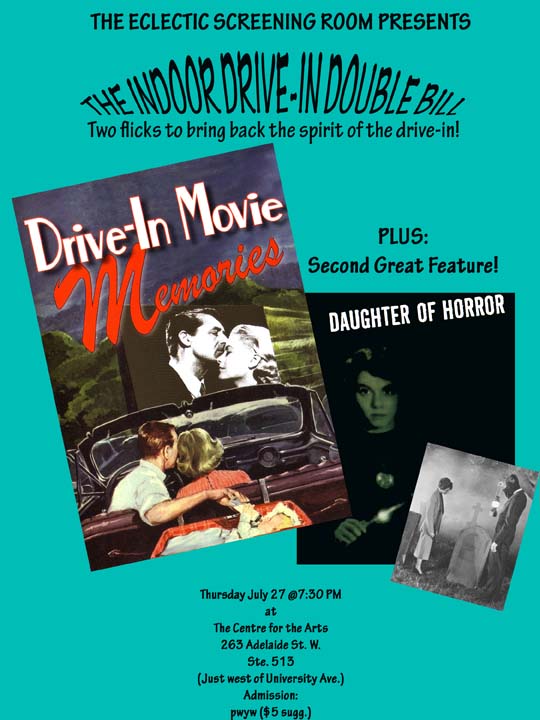
ESR Presents: The Indoor Drive-In


Well finally, after spending a long time thinking about it, I've started what I hope to be the monthly "theatrical" equivalent to ESR. The last Thursday of the month, you can now see The Eclectic Screening Room unspooling offbeat and interesting films at Centre for the Arts. Located at 263 Adelaide St. W., Suite 513, just east of John St., and about two blocks west of University, it is a cool little space, where the big studio room is used for the screening, and I have use of the lobby area as well to merchandise and sell refreshments.

The first screening, as you can see above, was the "indoor drive-in" festival, in which I first showed a lovely documentary DRIVE IN MOVIE MEMORIES, made in 2001. It is an hour-long feature giving an entertaining history of the drive-in from the 30's to present day, with lots of great nostalgia clips, and trailers, capturing the essence of the drive-in experience in its day. It also features interviews with Leonard Maltin, Beverly Garland, Sam Arkoff (I believe, filmed not long before he died), Celeste Yarnall and Robert Fuller, among others. Then I followed up with DAUGHTER OF HORROR, a mini-favourite of mine-- a completely mind-warping flick from 1955. It was first released in 1953 with the (far more accurate) title DEMENTIA-- with no onscreen dialogue, just music and ambient sounds on the audio. Then it was re-released with the title DAUGHTER OF HORROR, featuring narration by some guy named Ed McMahon!!! Although I prefer the earlier version, I screened the latter since it was public domain.

Our audience attendance was about a dozen customers. Not great, but I am rather glad I had a small crowd for the first screening. Since I was still working out the technical bugs right up till the first customers arrived, and still getting into the groove of running the gear (the switcher and what not), it just seemed best to do so with a group that was intimate enough which practically encouraged a "one on one" feeling. In that regard, the night almost felt like a friendly gathering as opposed to a clinical screening. Half of the audience was comprised of a meetup group entitled "We Don't Do Mainstream Film"-- somehow someone received notice of my screening at the last minute and posted it on the list. For that I am grateful. My friend Mike Ritz showed up, as did Will Sloan (who had contributed to the STILL in progress Roger Corman issue). Plus I was happy to see Chris Mitchell and Maria show up for the second film. The response to the films was polite, and it was a beginning.

As with any first-time screening at a venue, it was a trial by fire. But I learned a whole lot, and already have ways of making the next one better and smoother. End of August is Educational Film Night, or if you like, "ESR's Back To School Special". Hope to see you there.