Showing posts with label Film Noir. Show all posts

Sep 28, 2012

The Toronto Film Noir Syndicate


...and now that Word on the Street has past, it's time to continue to the next project I've been involved with for the past couple of months. Yours truly has joined Shirley Hughes and David Faris in The Toronto Film Noir Syndicate. This collective will be showing classic film noir several times throughout the year.

Tomorrow, Saturday Sept. 29 is our inaugural screening. This is the first of our fundraiser screening, in which we hope to raise funds and awareness for our plan to hold these events in the future at a theatrical venue.  Tomorrow's event will be held at the Dominion on Queen, 500 Queen St. #E.  The show begins at 8 PM-- admission is five dollars.

For further details, visit the syndicate's website by clicking here.

You can also like the Toronto Film Noir Syndicate on Facebook.

Sep 25, 2012

DVD Releases That We Dig This Week (09.25.12)


Brothers and sisters, if there is one DVD release this week that is after our own hearts, it is the set, Weird Noir: Six B-Movies, released from Something Weird.

How obscure are these films? Yours truly has only heard of half of them, and has seen none. All of these B-budgeted films noir harken from the 1950s and early 1960s.

Beverly Garland stars in Stark Fear (1962), who must convince people that her husband is going to kill her; detectives investigate a murder in a burlesque theatre in Girl on the Run (1953) (yup- that sounds like a Something Weird release….); Fallguy (1962) features a teenager who is mixed up in political intrigue and a murder he didn't commit; Jacques Bergerac (The Hypnotic Eye) and Mala Powers (Cyrano de Bergerac) star in Fear No More (1961), about a mentally unbalanced woman accused of murder on a train (and I LOVE train movies….); The Naked Road (1959) is a potboiler about a model who gets involved with a sleazy ad exec and other slovenly characters; and finally, there is The 7th Commandment (1961), directed and co-written by Irv Berwick (Monster of Piedras Blancas), about an amnesiac who is now a reverend, being swindled by an old flame. (I've been curious about this title for years!)


There you have it - a half-dozen little noir quickies that seem perfect for a rainy fall night. Does this mean that Something Weird is finally getting back into releasing factory DVDs? I sure hope so.

But wait! There's more! Today, Criterion also releases actor-director Paul Bartel's hilarious black comedy Eating Raoul (1982), also with his frequent co-star Mary Woronov! As bonuses, the package also features Bartel's early shorts The Secret Cinema (1968) and Naughty Nurses (1969).


All six of the popular Lone Wolf and Cub series of films (from 1972 to 1974) based upon the manga by Kazuo Koike are released in one set by AnimEigo, each featuring Tomisaburo Wakayama as the shogun hero: Sword of Vengeance (1972), Baby Cart at the River Styx (1973), Baby Cart to Hades (1972), Baby Cart in Peril (1972), Baby Cart in the Land of Demons (1973), and finally, White Heaven in Hell (1974).


Also, with ample time before Halloween, Redemption has released Mario Bava's underrated chiller Hatchet For the Honeymoon (1970).


Flicker Alley also has a couple of DVD/Blu-Ray combo packs for the widescreen aficionado this week. This week happens to also be the 60th anniversary of the widescreen process, Cinerama, which changed the scope of movies forever, in order to compete with television. 1952's This is Cinerama introduced movie goers to a whole new movie experience unlike any before. Also, lovers of the big screen process will be thrilled with another combo release: 1958's Windjammer: the Voyage of the Christian Radich. This chronicle of the Norwegian vessel, travelling from Oslo to the Caribbean was the only film to be shot in the Cinemiracle process. Largely unseen since its release, this has been painstakingly restored; and both of these are sure to be collector's items.


Dec 21, 2011

The Man In The Net (1959)

Director: Michael Curtiz
Writer: Reginald Rose, from a story by Hugh Wheeler
Producer: Walter Mirisch
Cinematographer: John F. Seitz
Music: Hans J. Salter
United Artists; 97 min, B&W

Cast:
Alan Ladd (John Hamilton), Carolyn Jones (Linda Hamilton), Diane Brewster (Vicki Carey), John Lupton (Brad Carey), Charles McGraw (Sheriff Steve Ritter), Barbara Beaird (Emily Jones), Susan Gordon (Angel Jones), Charles Herbert (Timmie), Steven Perry (Leroy)

John Hamilton is a former New York commercial artist who has fled with his wife to rural Connecticut to begin a new career as a painter. However, his wife Linda (yes, Linda Hamilton) misses life in the fast lane in The Big Apple, despite John's implications that her former lifestyle contributed to her "illness".  A recovering alcoholic who frets over a grey hair at age 28, Linda is especially upset that John will be turning down a lucrative job offer back in the city, preferring instead to toil away his time in his new career that brings neither acclaim nor fortune.

The implied conjugal tensions outwardly manifest themselves into this John Cheever-ish world when Linda appears one night at a birthday party, inebriated, and with a black eye that she falsely accuses John of giving her. Soon after, when Hamilton returns from the New York trip where he turns down the job offer, he finds that all of his paintings have been slashed, and his wife has disappeared.  In short order, Linda's body is discovered buried in the shed underneath fresh concrete. Since John is already labelled a cad among his friends and neighbours, thanks to his wife's accusation the previous night, he is naturally accused of murdering Linda and flees persecution by the police and the mob of townspeople.

The Man in the Net is a surprisingly enthralling film noir, and also an interesting credit late in the careers of both actor Alan Ladd and its prolific director, Michael Curtiz (who had helmed many Warner classics in the 1940s). At first, this movie seems like a pleasant enough variation on the "falsely accused man on the run" plot. Despite how formulaic this story may first appear, it is made engaging for the panache that Curtiz gives the material- he certainly knows how to set a mood with deceptively simple mise en scene. (And as we will see, this film is deceptive in many ways.) By 1959, Alan Ladd's career had been fizzling- his acting instincts had become tired and dulled, and had to accept star billing in second-rate pictures.  Yet in its own negative way, Ladd's taciturn, world-weary demeanour suits the character of a man who has been put upon both personally and professionally. Carolyn Jones is superbly cast as his estranged wife- with her Bohemian bangs suggesting that she ended up in Connecticut by way of Greenwich Village, Linda is truly a fish out of water in this rural environment- yearning instead for life in the fast lane, despite the consequences.  If you stretch it, this film could be a continuation of her Oscar-nominated role in The Bachelor Party (1957)- "The Existentialist" has left the Beatnik scene for the suburbs. 
 
ABOVE: Carolyn Jones
Any good film noir reveals the corruption beneath the surface of a supposedly civil society.  Yet rather than depicting a rainy, urban jungle this film juxtaposes the benign suburbia of New England with a story of adultery, blackmail and murder permeating the picture-postcard landscape. And still, despite moving the setting to an uncommon green oasis, this "man on the run" formula is further differentiated as it slowly evolves into a delightfully bizarre allegory.

In the final third of the picture, John receives aid from the children he has befriended while painting out in the meadows. The movie thus becomes a unique Utopian treatise, as the incorruptible kids not only believe John, and enact his complex and clever plot to prove his innocence, but the children forge their own unique society with a moral code of virtue, loyalty, and a tolerance of class, race and gender. (The leader of the kids is a girl, after all. Young Susan Gordon, in one of her few screen roles, is a delight as the kids' captain and den-mother: the Raggedy Ann doll she always carries symbolizes her maternity and strength.) Further, it is a delight to see the African American boy Leroy work and play in harmony with his white friends. (This film is one of the very few from an age of segregation that slyly presents fraternity among mixed races.) The adult world by contrast is Barbaric and archaic, adhering to an outdated structure where race determines class: for instance, Leroy's father is a servant for one of the white kids' parents.  Despite that the current ruling class of this supposedly picket-fence environment is revealed to be full of deceit, one actually finishes the movie with the hope that these children (already exhibiting a maturity beyond their years) shall inherit the world, and seed their goodwill for future generations. Perhaps the children find a kinship with John in that he is an artist, and also lives a supposedly carefree (shall we say? childishly innocent) existence outside of the constrains of the ruling class.

ABOVE: Alan Ladd, Susan Gordon


Sadly, The Man In The Net is nearly forgotten today- hardly considered a career highpoint for any of the people involved.  Seeing a film like this recalls Wheeler Dixon's book Lost In the Fifties: Recovering Phantom Hollywood (which I read last month, and will review here soon): its central thesis insists that one would do best to look at the 1950's film and television that have not remained in memory, as they will be the works that more accurately depict the times in which they were made.  Indeed, many works of the decade suggest a society of forced conformity, sexism and segregation; this film on the other hand offers a more hopeful message of harmony and equality.  Released just a few years before such social themes entered the collective consciousness, Man In the Net is a fascinating precursor of the changing times. A programmer it may be- but a wholly diverting one at that.  Like the characters onscreen, this movie has much more underneath than meets the eye.

May 23, 2011

Shock (1946)

Director: Alfred Werker
Writers: Eugene Ling (screenplay); Albert deMond (story); Martin Berkeley (additional dialogue)
Producer: Aubrey Schenck
Cinematographers: Joe MacDonald, Glen MacWilliams
Music: David Buttolph
20th Century Fox; 70 min; B&W

Cast:
Vincent Price (Dr. Richard Cross), Lynn Bari (Nurse Elaine Jordan), Frank Latimore (Lt. Paul Stewart), Anabel Shaw (Mrs. Janet Stewart), Michael Dunne (Dr. Stevens), Reed Hadley (District Attorney O'Neill), Renee Carson (Miss Hatfield - Head Nurse), Charles Trowbridge (Dr. H.J. Harvey)

While under contract for 20th Century Fox, Vincent Price was receiving good notices for his supporting work in historical pictures, as well as for his "cads" in Laura and Leave Her To Heaven. Aubrey Schenck thus decided to give the actor a leading role in this modest picture, which, despite the appearance of Price and the psychoanalysis theme, isn't a horror film, but a noir with psychological overtones. (Screenwriter Eugene Ling would also pen the classic noirs, Scandal Sheet for Phil Karlson, and Behind Locked Doors for Budd Boetticher.)

In his first top-billed role, Price plays Dr. Richard Cross, who kills his wife during an argument over an impending divorce. His deed is witnessed from a neighbouring hotel window by Mrs. Janet Stewart (Anabel Shaw). Already in a weakened mental state, she is discovered by her husband the following morning in a catatonic state. As coincidences in film noir would have it, she is treated by Cross himself, who has her committed to his own sanitarium in an effort to convince her that she is truly insane, having only imagined the murder scene.

According to the highly enjoyable but typographically challenged book Vincent Price Unmasked (by James Robert Parish and Steven Whitney), Shock received some bad notices upon its initial release for its negative portrayal of psychiatrists! Well, such controversy has receded over the years, but time hasn't been kind to this little film due an early, laughably bad dream sequence early where Janet is hearing the voice of her long-lost husband, and dashes to a giant doorknob (how Freudian): she is clearly seen running on one spot!

ABOVE: Vincent Price, Lynn Bari

More interesting is the relationship between Cross and his lover, Nurse Elaine. After five decades of roles in which Vincent Price commits many ghastly, vengeful acts onscreen, it is refreshing to see that this lead role features him not as a monster, but rather a remorseful man who nonetheless attempts to cover up his fatal mistake. However, he still has a moral center dictating to what measures he will carry out his deeds: "There is a limit beyond which even I can't go". It quickly becomes clear that Elaine is pulling his strings, convincing him to perform even more insidious things like shock therapy to drive Janet beyond the brink.

ABOVE: Vincent Price, Anabel Shaw
This modest programmer is also helped along by some moody photography (which I'd perhaps attribute to Joe MacDonald, as the deep blacks are similar to those in My Darling Clementine, released the same year), and some effective mise-en-scene (where it conveniently rains and storms during suspenseful moments). The supporting performances by some familiar players are decent if unspectacular. Anabel Shaw's smallish frame captures the essence of the victimized Janet, although the actress is largely given little to do but hyperventilate and stare slack jawed. Still, it is Vincent Price's movie all the way: his solid performance carries this inoffensive second-feature. While Shock is a minor time killer, it is however an interesting footnote in his developing screen career- it would be among the few lead roles where he plays a human monster that still has a heart.

Jan 15, 2011

The Killer That Stalked New York (1950)


In the late 1940's and early 1950's, many films noir were made with a pseudo-documentary approach, whose realism was heightened with a dry voiceover narration, and shot on authentic urban locations.  While this movie is not the best example of this style, it is an interesting mosaic.  The deceptive title does not refer to a psycho killer, but rather tells the story of a woman on the lam from the police, who unknowingly is carrying the smallpox epidemic.  This inferior B-movie cousin to Kazan's Panic In The Streets (released the same year) is ambitious in theory, if not scope. 

It is a very interesting concept to see Evelyn Keyes being trailed by both the police and the health organization (neither body is aware the other is also after her), and as such, this no-frills package instead spends time on exposition than characterization. Evelyn Keyes has had more impressive showcases in other noirs (see my reviews of 99 River Street and The Prowler), as she is given little to do but wander from one vignette to the next.  However, this little movie is engaging filler for a lazy Saturday afternoon.  B movie addicts will likely react to many familiar faces that appear throughout this busy mosaic (Dorothy Malone, Lola Albright, Harry Shannon).  Whit Bissell is most memorable, appearing as Keyes' estranged brother who briefly offers her shelter in his flophouse.

99 River Street (1953)


Open on grainy footage inside a sweaty, crowded boxing arena. Cut to closeup of boxer Ernie Driscoll getting hit in the face- sweat sprays onto the camera. Cut to a shot of Driscoll watching himself box on the television set. The television narrator remarks that this was Payne's final fight. Cut to an extreme closeup of Ernie's eyes and sweaty forehead. His eyelids blink when the narrator explains that an eye injury ended his career.

This decoupage, which opens 99 River Street, is compact storytelling at its best. We learn all we need to about our flawed hero in little screen time, and have had that communicated visually. Within these few moments we learn that our protagonist has had a fall from grace, and is prone to violence: classic traits of a film noir anti-hero. These first few moments also personify the economy of B-movies at their best: lean, no-nonsense prose with not a moment wasted- a perfect example of achieving much by working with so little.

Driscoll (John Payne) now works at night driving a taxi, and on the surface he seems to enjoy his new environment: trading quips with his dispatcher (Frank Faylen- best remembered today as the sadistic orderly in The Lost Weekend and the cab driver in It's A Wonderful Life) and struggling actress Linda James (Evelyn Keyes) who likewise hangs out at the local diner. But as that opening sequence also suggests, all is not well below the surface, which is about to erupt. He just discovers that his wife Pauline (blonde bombshell Peggie Castle) is cheating on him with a two-bit mobster (Brad Dexter), who then kills her over complications with obtaining stolen jewels and plants her body in Ernie's taxi! For the rest of the film (which takes place entirely in one night), Payne, with the help of Keyes, tries to track down the hoods who were involved with her death, and evade the police in the process.

From those opening shots, this movie simply does not let up, save for the rushed resolution. The story seems to change with every other scene, and no matter how outrageous this scenario escalates it is always kept believable, not that we are given much time to ponder such things. The cast reciprocates with game energy for the colourful roles they are given. Evelyn Keyes is given a great scene that most thespians would starve for, describing the sensation of being forced to kill someone out of defense-- all presented in one single take. While the camera remains on her throughout this scene, we "see" the act in our minds. This deceptively simple approach is a marvel of cinema. There is also a good supporting role for Jack Lambert (a familiar character player of the decade) as a mob flunkie who often crosses paths with Payne in this long night.

99 River Street
may be the best of director Phil Karlson's noirs, made on a roll in the 1950's, and bears his distinctive docu-realism style (exemplary also in The Phenix City Story). This film is largely a symphony of close-ups and low angles, offering a lean, mean depiction of the world of violence and deceit into which Payne is thrown.

Aug 11, 2005

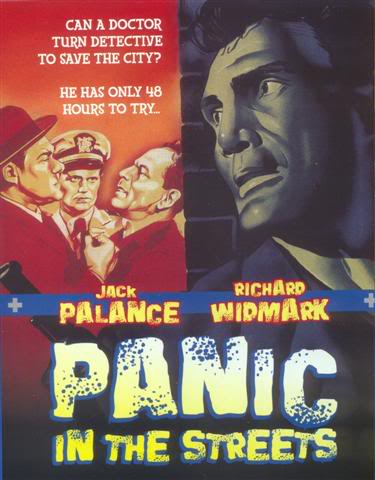
Panic in the Streets (1950)

In remembrance of Barbara Bel Geddes, who just passed away, today's movie is Elia Kazan's amazing noir thriller PANIC IN THE STREETS (1950). Although TV Nuts from the last 30 years will best remember her as JR's mom in "Dallas", classic movie fans possibly best recall her as the woman who stood by Jimmy Stewart while he messed around with Kim Novak in VERTIGO (1958). Prior to that, however, this stage actress did a string of classic films noir in the late 1940s- Max Ophuls' CAUGHT and Anatole Litvak's THE LONG NIGHT (1947). Ms. Geddes' roles on film seemed to typefy the all-American woman that men would eventually come home to after venturing in the dark side.

Richard Widmark is a doctor racing against time to find a murderer who is also the carrier of a plague! Film also features some great work by Jack Palance and Zero Mostel as the heavies, plus superb use of sweaty seedy New Orleans locations to add to the authenticity. Also a plus is the expert use of long single takes. Despite a lot of the success accorded his later years (STREETCAR NAMED DESIRE, EAST OF EDEN), Kazan nonetheless remained a controversial figure because he named names at the McCarthy hearings to save his own hide. Therefore, it is ironic in the way that Widmark makes a speech in front of some dock workers for someone to come forth and name someone they are looking for as they are a danger to society! For all that, though, when his day's work is done, Dr. Widmark comes home to his wife (Ms. Geddes) in nice boring 1950's suburbia. Not only that, but Tommy Rettig (from TV's "Lassie") plays their son! How's that for 1950's wholesomeness?