Showing posts with label 50's Cinema. Show all posts

Apr 1, 2013

Cape Canaveral Monsters (1960)


Writer-Director: Phil Tucker
Producer: Richard Greer
Music: Guenther Kauer
Cinematographer: W. Merle Connell
CCM Productions; 69 min; B&W
Cast: Jason Johnson (Hauron), Katherine Victor (Nadja), Scott Peters (Tom Wright), Linda Connell (Sally Markham)

One Saturday night, or more accurately, Sunday morning in the fall of 1989, I was scanning the listings of TV Guide and caught a listing for Phil Tucker's Grade Z science fiction epic, Cape Canaveral Monsters, scheduled to air on City TV at 4:30 that morning.  Having seen Robot Monster (1953) by the same director, I was excited at the rare chance to see his "other" science fiction film that I had only read about in Michael Weldon's "Psychotronic" Guide.  Putting the VCR to work, I had also elected to watch the recording in progress for as long as my stamina allowed.  And what little I did catch before nodding off was enough to make me love this little movie forever.

The lo-fi quality of the film is established right away with these two cartoon spheres zooming in and out on a black background (something that Norman McLaren would’ve made the first week of animation class), as a booming female voice is heard on the soundtrack: “I TOLD you we would find suitable bodies here, Horaun!”  Then we see these two tiny pieces of animated light on a rocky shore as a man and woman leave their idyll on the beach and get in the car.  Before you know it, the little spheres jump into the heads of the people in the automobile, instantly causing the car to veer out of control and kill them both (I guess these extraterrestrial beings, who cause so much mayhem in the next hour, don’t know who to operate a vehicle). (In one inspired shot, we see a mannequin arm dangling out the rear window.)  But wait!  Because the spheres had entered these human bodies, we see these bloodied corpses come back to life and struggle their way out the passenger’s side of the car.  “Horaun! Your arm!” the woman cries, and reaches back into the seat to collect the missing limb dangling from the smashed rear window.


This lively opening remains one of my favourite bad movie moments: it is a piece that seems made for the wee hours of the morning, where such surrealism can joyously tickle one's oxygen-deprived brain cells, before daylight emerges to wipe away all of the mysteries of the night. This scene fills me with juvenile nostalgia just thinking back on it.  Upon revisiting this movie after several years, however, expecting to rekindle that same kind of innocence, I was surprised to find that beneath the tacky production values and choppy plot, this is a much more bleak film than I remembered all those years ago, and one perhaps encapsulating the career of its creator, the enigmatic Phil Tucker.

Tucker is best remembered today for his masterpiece Robot Monster, in which a creature in a gorilla suit and diving helmet terrorizes the last few surviving humans on earth.  Its scant hour-long running time is a spirited piece of pulp, featuring a menace whose greatest threat is shaking his fist, a bouncy glockenspiel score by a young Elmer Bernstein, and such avant-garde touches as incongruous footage lifted from One Million B.C.  Had he made just this one picture, Tucker’s name would still be high in the annals of “so-bad-they’re-good” movies.  However in short order, he partnered with comedian Lenny Bruce on the sleaze classic, Dance Hall Racket (1954), and Dream Follies (1953)- one of the several burlesque pictures that the bargain basement auteur would make throughout the 1950s.

Yet still, little remains known about this cult figure (I deliberately ignore a short section on Tucker in The Golden Turkey Awards, because I question its authenticity). One most notorious piece of publicity surrounded Tucker’s threat to commit suicide shortly after the release of Robot Monster (not because of the film’s bad reception, as it was most commonly believed, but over his being cheated of profits from the movie, because it did make money).  But, because Tim Burton made Ed Wood instead of Phil Tucker, and no one has written a book-length study of his work on the level of those for Andy Milligan or Al Adamson, one could say that this auteur is one of the last frontiers of bad filmmaking to be re-discovered.

Despite that most of Phil Tucker's filmography is easily found on DVD today (mostly on the Something Weird label), Cape Canaveral Monsters (1960) remains the dark horse of his career (in more ways than one). It is just the kind of movie one would expect to find relegated to a mere two-line blurb in TV Guide, banished to the most obscure hour for a meager appearance to the scant few who would be watching it in the semi-conscious state that this film evokes (with his choppy narrative that resembles dream logic).  As of this writing, it has never had an official home video release (Republic currently owns the rights... what are they waiting for?).  Few have seen it, and many more should.  One’s inability to find more production history, posters or stills for to the picture makes this equally as enigmatic as its creator.

Like many of his Tucker’s films, this too is hokey, threadbare, and sometimes lethargic. The plot revolves around extra-terrestrials Hauron and Nadja, who assume human bodies to freely move about and thwart missile launches at Cape Canaveral, thus delaying Earth’s advances in the space program so the alien race can move in and conquer.   While we’ve often seen variations on this idea in the most generic 50’s sci-fi, the movie also adds a busy subplot of the aliens back in their ship, hidden in a cave, transporting human specimens back to their home planet for study.  Thus, in between missile launches, Hauron searches for unwitting victims in Lovers Lane!  Thank goodness the aliens’ fiendish plot is uncovered by young scientists, and would-be lovers, Tom and Sally (played by actors who are perhaps too old for their roles, but weren’t all young lovers in 1950s movies played by thirty-five-year olds?).


As such, this busy plot line results in a lot of scenes with little continuity, and even less logic, especially in how things get resolved by scientific methods that perhaps won’t be questioned by the viewers as long as they failed grade eleven physics. And while there were surely cheaper science fiction films made in the day, this is the kind of movie featuring humans and aliens alike looking offscreen to stock footage shots of rockets and explosions. (But truthfully, since some of this film’s exterior footage is as grainy as the stock shots, sometimes the editing is seamless.)  Despite that Hauron spends half the film without an arm, no one bothers disguising that the actor’s left limb is hidden in his shirt. Since the aliens have the technology to travel across the stars and assume human bodies, even the most undemanding drive-in patron couldn’t suspend one’s disbelief at such props as a spotlight which acts as a magnetic field, or a telecommunications device that resembles a revolving pancake in a jar.  (Not even the bubble machine in Robot Monster approaches this level of lo-tech wizardry.)

Cape Canaveral Monsters indeed seems hokey and threadbare, but like works from such mavericks as Larry Buchanan or Edward D. Wood Jr. who had a lot to say for themselves even within the stifling confines of Grade Z movie production values, there is a some poetry going on beneath the surface, if one chooses to look. Despite how much one may titter at the tawdry production, it is evident that some of the humour in this dour little epic is intentional- call it Flash Gordon Meets Samuel Beckett. In a blackly comic first half, Hauron’s arm continues to fall off (first in a car accident, then by way of a hungry guard dog), and must find another arm to replace it, so he can remain in the human state he obviously despises. It is an interesting touch to see the aliens committing acts of evil while inhabiting decaying corpses! (Mounds of makeup are applied on the actors’ faces to simulate their crumbling host bodies.)

While retroactively it is an easy ploy to think of even these silly aliens as a metaphor for the Red Scare of the era, one cannot recall another pair of extraterrestrial villains that are so uncomfortably human. This matinee fodder brazenly injects Edward Albee into its plot with a pair of bickering aliens, who are either seen arguing or commenting on a previous fight. It is implied too that Nadja is a lusty Id to Hauron’s Superego, as she is less in a rush to transport these young Earth bodies away. Perhaps there is another matter of the human flesh she wants to investigate?

Because it is a science fiction picture, this movie is always compared to Tucker's other fantasy film, Robot Monster. However, since Cape Canaveral Monsters is written by its director, one is more inclined to compare it to another film he wrote as well as directed: his no-budget Sunset Blvd. knock-off, Broadway Jungle (1955).  Both of these movies feature raving lunatics in positions of power (in Cape Canaveral Monsters, it is not just the aliens, but the German scientist and the caricatured cigar-chomping military figures). Additionally, each film displays Tucker’s knack for choosing the most overacting thespians on the unemployment line.  Both works end on a sarcastic note, in which there is a draw between good and evil, and all the preceding action is a shaggy dog joke.  There is little levity in the cinema of Phil Tucker- perhaps having made a decade’s worth of desperate movies on the outer fringes of Hollywood would influence such pessimism.

Yet even in pictures written by others, many of Tucker’s works deal with repression.  Dance Hall Racket achieves a Dreyer-like kind of minimalism, whose non-existent art direction compliments the empty lives of its characters that briefly attain some affection that is as artificial as the silly palm tree behind them.  Dream Follies opens with a stifling shot that endlessly pans between office workers and the wall clock, as they count down the seconds to escape.  Likewise, Cape Canaveral Monsters is full of longing and unrequited desire.  Sally’s scientist uncle (who is conducting the missile launches) berates Tom for “making goo-goo eyes at my niece”.  (Yet, who can blame him?  She is a fox behind those glasses!)  In the scene featuring the double-dating young scientists, the first dialogue we hear is their complaints of being under the control of their parents at the base.  Likewise, it is implied that at least one half of the alien duo is repressed, as Nadja is eager to examine the human body in more ways than one.

Cape Canaveral Monsters would be the last time that Phil Tucker blessed us with his directorial gifts.  He would spent the rest of his career in post-production, even on such high profile films as King Kong  (1976) and Orca (1977).  His last feature credit was as sound editor on the Betsy Russell stinker Out of Control (1985).

Phil Tucker’s final foray in the directors’ chair was also a family affair.  Cinematographer W. Merle Connell had previously lensed or edited several of Tucker’s films.  (His daughter Linda plays Sally, in her only role.)  In one of his sporadic assignments as director, Connell had secured his place in exploitation cinema with the classic, Test Tube Babies.
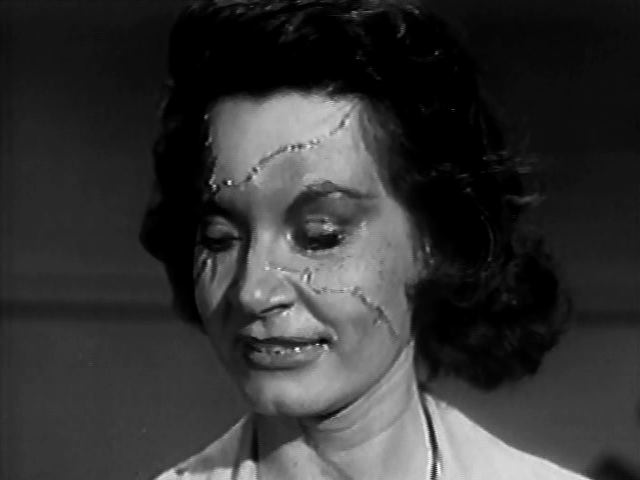

It is also interesting to see Katherine Victor as the villainous Nadja. While rather unrecognizable beneath all that makeup, she is engaging as the randy extra-terrestrial.  The actress largely received employment in films by Grade Z director Jerry Warren, especially the classics Teenage Zombies and The Wild World of Batwoman.

Fittingly, Tucker’s career as a writer-director ended with the close of the 1950s.  As a freer, more hedonistic culture was to emerge in the swinging sixties, the repression that seemed so synonymous with his work (and that decade) would soon fade away.  Cape Canaveral Monsters is an appropriate swansong, as it encapsulates these themes,  but it is also representative of the joys to be found in the so-called “bad movies” that mainstream society likes to shun.  Despite their obvious shortcomings, there is much sincerity to be found in these misunderstood little children.

Since the tradition of the late night movie has all but disappeared since that night I first discovered this picture, the only way that Cape Canaveral Monsters can hope to find its deserving audience is on DVD.  And it wouldn’t be a moment too soon—it is time for Phil Tucker again.

Aug 2, 2012

Edge of Hell (1956)


Writer-Producer-Director: Hugo Haas
Music: Ernest Gold
Cinematographer: Eddie Fitzgerald
Universal; 78 min; B&W

Cast:
Hugo Hass (Valentine), Francesca De Scaffa (Jenette), June Hammerstein (Helen), Jeffrey Stone (Freddie), John Vosper (Mr. Hawkins), Ken Carlton (Billy)


The Czech-born Hugo Haas (1901-1968) was a highly regarded actor-writer-director in his native land [one of his indigenous directorial efforts, Skeleton on Horseback (1937), received raves at a recent one-shot New York screening], who like many filmmakers fled to America when World War 2 broke out.  Because he didn’t have conventional movie idol looks, the brawny Haas was instead given supporting character parts, often as villains or exotic roles (namely in such classics as Douglas Sirk’s melodrama Summer Storm, or the 1950 adventure film King Solomon’s Mines).  As the 1950’s began, Hugo Haas instead turned his attention to writing, producing, directing and co-starring in B-budgeted potboilers.  The tantalizing titles of these films evoke those of trashy drugstore paperbacks, or at least the magazines at the checkouts (The Other Woman; Pickup; One Girl’s Confession; Bait).  According to his fellow countrymen, his foray into such sensationalist fare, with tawdry budgets and lurid plots, was a long way from his work in his native land.  Also, because his work has been out of proper circulation for decades, it has been largely misrepresented as camp, or “so bad they’re good”, ironically due to the very scraps of cult film writings have kept his name alive for new generations.

One could call Hugo Haas a B-level Orson Welles: both would appear before and behind the camera in their pet projects and make the best with whatever resources they had.  Many filmmakers have successfully created an identifiable body of work within B-budgeted genre fare.  In truth, Hugo Haas’ films lack the innovative cinematic devices of poverty row auteur Edgar G. Ulmer, or for that matter, even the spacey literary visions of Edward D. Wood (to whom Haas has sometimes stupidly been compared by so-called cult film writers who should know better).  Yet they do have a unique personality: these modest pictures somehow belie their tawdry, lurid elements and become fascinating morality plays with surprising turns of redemption, sentimentality, and old world values.

The major criticism of Haas’ films is however well founded.  The writer-director would often cast himself in as the unlikely lead, who would have a doomed affair with a deceitful blonde woman who often had a young beau on a string to form a torrid love triangle.  And after seeing several of his films in a short time period, this formula becomes tiresome.  He would most commonly hire Cleo Moore as the female lead, but each of the lead actresses in his Hollywood epics is typically given ingĂ©nue roles taken under the wings of Haas’ own characters, suggesting a Svengali-Trilby plot device that further aggrandizes his own roles.  (To his credit though, Haas always gave good performances.)

Hugo Haas never shied away from outrageous symbols or heavy-handedness to make his point- and one of the definitive examples of that is in the deceptively titled Edge of Hell (1956), which may be the masterpiece of his thirteen American films as director.  It is a departure from his usual “deceitful femme fatale” formula: a Damon Runyon-esque fable that is by turns hilarious and tragic, culminating into a finale, which is outrageous, but not logically wrong.

Haas stars as Valentine (rhymes with “teen”), a vagrant who lives in the basement of an apartment house, and makes a meager living by performing on street corners with his dog Flip, and always within one step ahead of the law.  Like many of Haas’ characters, Valentine has fallen from the grace of his former glory days: he was once an actor and vaudevillian.  As the story progresses, he redeems himself upon being hired to perform with his dog at a child’s birthday party in the estate of wealthy Mr. Hawkins, arranged by Valentine’s neighbour Helen through her chauffeur boyfriend Freddie.  The refined Hawkins takes an instant liking to the earthy Valentine.  A delightful sequence in which the tramp performer entertains Hawkins with stories while the men share cigars and drinks is reminiscent of the moments in Chaplin’s City Lights (1931), where the Little Tramp is invited out by a drunk millionaire.  Thankfully, there is no scene where Valentine is turned out on his ear.  However, Hawkins exercises his rich person’s belief that money can buy anything when he offers an absurd amount of money to purchase Flip, since his kid won’t stop crying about wanting the dog.  Of course, Valentine turns down the proposition.  With the money that he made from the birthday party engagement, however, Valentine decides to share his wealth by throwing a party in his basement flat, in a truly wonderful scene that recalls the Frank Capra films of another era.  Indeed, the sentimental movies that Haas would make in the twilight of his career would seem out of the time in which they were made- more married to the tradition of 40s programmers than those of the late 1950’s.

However, I doubt that even Capra had concocted such a fascinating collusion of social class than this affair.  Throughout the film, Valentine’s hobo friends who live under the bridge are seen as aristocrats in tattered clothing.  They discuss their panhandling earnings in a patter similar to tycoons’ discussing stocks.  It is a joy to see these disparate characters thrown together in this party sequence—even the swarthy characters, like the slinky French girl Jenette and her shifty boyfriend Billy are equally welcome to share in Valentine’s good fortune.  Even at this soiree, the tramps (doubling as doormen) talk business like oil magnates, while the others drink and dance to phonograph records.  Still, the jibes against power and capital pervade the conversation.  (“Are you proud of your grandson?”  “He could be worse- he could be a politician.”)

Up until this moment, one wonders why the film is called Edge of Hell.  The title is justly earned after this wonderful scene, as the movie quickly changes in tone (even the overall look of the film, shot by Eddie Fitzgerald, becomes darker).  Some time has passed since the party, and we learn that Valentine has asthma (ironically, Hugo Haas would die of complications with asthma in 1968), and hasn’t been able to earn money on the streets.  He is eventually forced out of his home for non-payment of rent, and takes residence under the bridge with his hobo friends.  Meanwhile, Flip becomes ill, and Valentine realizes he is no longer able to take care of the dog properly, so he reconsiders selling the canine to Hawkins.  However, since Valentine is so desperate to get Flip a good home, he leaves with whatever small amount of money the butler had on hand at the moment.  Once Billy discovers that Valentine has sold the dog (knowing that he was once offered a tidy sum for Flip), he assumes that Valentine is loaded with money, and plots to rob him.  Helen and Jenette learn of his plan, and race to save Valentine in time.
ABOVE: Hugo Haas, June Hammerstein

The progression from light-hearted whimsy to tragedy is expertly maintained, culminating into a climax that is truly heartpounding.  Throughout the film, Valentine often associates his panhandling routines with acting.  Even in his final moments, he utters: “Don’t cry darling, I’ve been an old ham all my life; what can be greater for an actor than a death scene, don’t spoil it”.  The film however ends on an outrageous turn, smacking of “writer’s convenience” that would cause uproar in Screenwriting 101, as Valentine and Flip die at exactly the same moment.  While obviously contrived, this moment summarizes how Valentine and Flip are meant to be together for eternity.  Further still, Haas adds a bizarre finale, in which the man and his dog appear in front of a starry background, with liberal use of dry ice in the frame.  “Lord, can I show you some tricks?”  Roll of thunder. “Eternal life contract with no options.”  The background lights up, the music swells, THE END.

Haas was never so blatant with his spiritual overtones.  His supporters and detractors alike would have to agree, upon viewing this finale, that Hugo Haas was absolutely fearless in his pursuits.  Not only was he successful in making commercially viable movies while still filling them with his personal themes, no device was too heavy-handed enough to communicate his ideas.

Edge of Hell charts the path the Haas would take in the latter half of his career. He would gradually progress from noirish melodrama into more sentimental projects: Born to Be Loved (1959) and Paradise Alley (1962) are old-fashioned delights that deserve posts of their own. Hugo Haas would return to Europe and occasionally appear on television. Apparently, his star never diminished in Czechoslovakia: the works he made in his homeland during the 1930’s still draw an audience whenever they are played.

His Hollywood filmmaking career, however, is all but forgotten, and if one were to believe historians, justly so. Because Hugo Haas’ work has been out of circulation for so many years (save for scattered television play dates), a lot of misconceptions about his work have grown, and the inability to see his work in proper channels has allowed its unfairly negative reputation to grow.

In this age of information, it is astonishing how much Hugo Haas continues to be out of the public eye.  If one allows oneself to look beyond the poor production values, there is a genuine personality and richness to be found in his art.  Then as now, with so many movies being anonymously cranked out on the assembly line, Hugo Haas succeeded in being an auteur in the most subterranean antechamber of the Hollywood studio system.  Imperfect though they may be, the American films of Hugo Haas are worthy of re-discovery.

(Note: the above review is excerpted and abridged from an article on Hugo Haas, reviewing twelve of his American films, appearing in ESR #23, which is available at our store.)

Dec 21, 2011

The Man In The Net (1959)

Director: Michael Curtiz
Writer: Reginald Rose, from a story by Hugh Wheeler
Producer: Walter Mirisch
Cinematographer: John F. Seitz
Music: Hans J. Salter
United Artists; 97 min, B&W

Cast:
Alan Ladd (John Hamilton), Carolyn Jones (Linda Hamilton), Diane Brewster (Vicki Carey), John Lupton (Brad Carey), Charles McGraw (Sheriff Steve Ritter), Barbara Beaird (Emily Jones), Susan Gordon (Angel Jones), Charles Herbert (Timmie), Steven Perry (Leroy)

John Hamilton is a former New York commercial artist who has fled with his wife to rural Connecticut to begin a new career as a painter. However, his wife Linda (yes, Linda Hamilton) misses life in the fast lane in The Big Apple, despite John's implications that her former lifestyle contributed to her "illness".  A recovering alcoholic who frets over a grey hair at age 28, Linda is especially upset that John will be turning down a lucrative job offer back in the city, preferring instead to toil away his time in his new career that brings neither acclaim nor fortune.

The implied conjugal tensions outwardly manifest themselves into this John Cheever-ish world when Linda appears one night at a birthday party, inebriated, and with a black eye that she falsely accuses John of giving her. Soon after, when Hamilton returns from the New York trip where he turns down the job offer, he finds that all of his paintings have been slashed, and his wife has disappeared.  In short order, Linda's body is discovered buried in the shed underneath fresh concrete. Since John is already labelled a cad among his friends and neighbours, thanks to his wife's accusation the previous night, he is naturally accused of murdering Linda and flees persecution by the police and the mob of townspeople.

The Man in the Net is a surprisingly enthralling film noir, and also an interesting credit late in the careers of both actor Alan Ladd and its prolific director, Michael Curtiz (who had helmed many Warner classics in the 1940s). At first, this movie seems like a pleasant enough variation on the "falsely accused man on the run" plot. Despite how formulaic this story may first appear, it is made engaging for the panache that Curtiz gives the material- he certainly knows how to set a mood with deceptively simple mise en scene. (And as we will see, this film is deceptive in many ways.) By 1959, Alan Ladd's career had been fizzling- his acting instincts had become tired and dulled, and had to accept star billing in second-rate pictures.  Yet in its own negative way, Ladd's taciturn, world-weary demeanour suits the character of a man who has been put upon both personally and professionally. Carolyn Jones is superbly cast as his estranged wife- with her Bohemian bangs suggesting that she ended up in Connecticut by way of Greenwich Village, Linda is truly a fish out of water in this rural environment- yearning instead for life in the fast lane, despite the consequences.  If you stretch it, this film could be a continuation of her Oscar-nominated role in The Bachelor Party (1957)- "The Existentialist" has left the Beatnik scene for the suburbs. 
 
ABOVE: Carolyn Jones
Any good film noir reveals the corruption beneath the surface of a supposedly civil society.  Yet rather than depicting a rainy, urban jungle this film juxtaposes the benign suburbia of New England with a story of adultery, blackmail and murder permeating the picture-postcard landscape. And still, despite moving the setting to an uncommon green oasis, this "man on the run" formula is further differentiated as it slowly evolves into a delightfully bizarre allegory.

In the final third of the picture, John receives aid from the children he has befriended while painting out in the meadows. The movie thus becomes a unique Utopian treatise, as the incorruptible kids not only believe John, and enact his complex and clever plot to prove his innocence, but the children forge their own unique society with a moral code of virtue, loyalty, and a tolerance of class, race and gender. (The leader of the kids is a girl, after all. Young Susan Gordon, in one of her few screen roles, is a delight as the kids' captain and den-mother: the Raggedy Ann doll she always carries symbolizes her maternity and strength.) Further, it is a delight to see the African American boy Leroy work and play in harmony with his white friends. (This film is one of the very few from an age of segregation that slyly presents fraternity among mixed races.) The adult world by contrast is Barbaric and archaic, adhering to an outdated structure where race determines class: for instance, Leroy's father is a servant for one of the white kids' parents.  Despite that the current ruling class of this supposedly picket-fence environment is revealed to be full of deceit, one actually finishes the movie with the hope that these children (already exhibiting a maturity beyond their years) shall inherit the world, and seed their goodwill for future generations. Perhaps the children find a kinship with John in that he is an artist, and also lives a supposedly carefree (shall we say? childishly innocent) existence outside of the constrains of the ruling class.

ABOVE: Alan Ladd, Susan Gordon


Sadly, The Man In The Net is nearly forgotten today- hardly considered a career highpoint for any of the people involved.  Seeing a film like this recalls Wheeler Dixon's book Lost In the Fifties: Recovering Phantom Hollywood (which I read last month, and will review here soon): its central thesis insists that one would do best to look at the 1950's film and television that have not remained in memory, as they will be the works that more accurately depict the times in which they were made.  Indeed, many works of the decade suggest a society of forced conformity, sexism and segregation; this film on the other hand offers a more hopeful message of harmony and equality.  Released just a few years before such social themes entered the collective consciousness, Man In the Net is a fascinating precursor of the changing times. A programmer it may be- but a wholly diverting one at that.  Like the characters onscreen, this movie has much more underneath than meets the eye.

Aug 9, 2010

The Day The Earth Stood Still (1951)... Patricia Neal (1926-2010)


When one devotes his or her fleeting spare time to researching films for upcoming projects, it becomes difficult to re-visit old favourites. And likewise, I had forgotten how much I loved this film until seeing it again last week for the first time in roughly 20 years. After just viewing the first few expository scenes on television, I was hooked, and spent the next two hours re-living the majesty, excitement and profundity of this classic science fiction film.

One of the first of the archetypal "alien invader" movies of the 1950's, The Day The Earth Stood Still features Michael Rennie as the extra-terrestrial named Klaatu, whose flying saucer touches down on Washington D.C. to have an audience with the world leaders about how their eventual discovery of weapons of mass destruction will even endanger life on other planets. However, this seemingly benevolent alien offers an ultimatum: disarm or be destroyed. Mind you, he barely has time to deliver the message, as the hostile humans shoot him. Since Klaatu looks human, he's able to leave the hospital and blend in with the general public-- assuming the pseudonym of "Mr. Carpenter", he moves into a rooming house, befriends a young widower named Helen Benson (Patricia Neal), who also rents there with her son Bobby, who helps him with conveying his message.


This movie remains enjoyable because no-one on this A-list project treats it with anything other than tact and seriousness: the performances are marvellous (even Rennie's usual rigidity well suits the sometimes aloof alien)- none better than Sam Jaffe as the scientist who also sympathizes with his cause, the screenplay is as timely as ever (the more things change...), and as far as I'm concerned, the special effects still hold their own against today's CGI. The best effect is, if one may say, the most human: seven-foot-seven theatre doorman Lock Martin as Klaatu's only travelling companion, Gort the robot, who can shoot laser beams out of its visor. The dramatic highpoint occurs in a show-stopping sequence that gives the film its title: Klaatu orchestrates a world-wide power shutdown (save for emergency wards and operations) which subtly and effectively demonstrates the weight of his words. (This scene no doubt influenced Roger Corman's It Conquered The World). Director Robert Wise was given this project at the perfect time of his career. He was still a decade away from much bigger films like West Side Story, but still directs this modest production with a lightning pace that would more befit the B-movies he had previously made with RKO.

Admittedly, nearly sixty years has robbed the film a bit of lustre: Hugh Marlowe's character- Helen's boyfriend Tom Stevens (an egomaniac who wants to exploit Klaatu's whereabouts), is a bit much, perhaps too calculatedly written just to give the movie an equal balance of right and left-leaning politics. Plus, it is amusing how Mr. Carpenter can easily get residence without any money, luggage or references: perhaps the 50's really were this innocent and wholesome!

Despite that the picture remains a major addition to the 50's sci-fi genre, time would make it even more part of that decade's iconography, as the "white picket fence" milieu of the age is enforced by the early roles for Billy Gray (of "Father Knows Best") as Bobby, and Frances Bavier (Aunt Bee from "The Andy Griffith Show") as another tenant of the rooming house. This movie is such an icon of pop culture that "Klaatu Barada Nicto" has become a catchphrase among genre fans, and Klaatu has inspired at least one rock band and at least one album cover. As well as grand entertainment, The Day The Earth Stood Still remains topical now as then for its themes of universal harmony and tolerance: two things still unattainable to some in our modern world.


View trailer.

++++++

Later that night, I was wondering if actress Patricia Neal was still with us (as the last time I saw her was in Robert Altman's fable Cookie's Fortune), and made a mental note to check that fact when I penned the review. After finally getting to post this today, I experienced another case of "Barry Morse Syndrome" upon learning that she passed away only yesterday at the age of 84. Ms. Neal was one of the definitive actresses of her generation, having appeared with then-beau Gary Cooper in the adaptation of Ayn Rand's The Fountainhead (1949) and Bright Leaf (1950); and with John Wayne in Operation Pacific (1951), before starring in tonight's film. Although her film work throughout the decade was sporadic (more often seen on the small screen and especially on Broadway), she appeared in such key films as A Face in the Crowd (1957), Breakfast At Tiffany's (1961) and Hud (1963), for which she won the Oscar as Best Actress.

In 1965, Ms. Neal suffered a series of strokes while her fifth pregnancy (married to Roald Dahl), and successfully recuperated to re-appear onscreen in The Subject Was Roses (for which she received another Oscar nomination). Over the next three decades, her cinema work was sparse but noteworthy, including a supporting role among many veteran stars in the underrated Ghost Story (1981); An Unremarkable Life (1989) and as the title role in Altman's southern comedy Cookie's Fortune (1999). This 1951 classic was a reminder of her superb an actress she was, and will have to re-watch some more of her work in the near future.

Jan 7, 2008

Five (1951)


Arch Oboler was a pioneering showman of radio drama (often gruesome melodrama with an attention to ambient sound) before he broke into the movie business. Among his scant output as a director is the very first 3D feature, Bwana Devil (1952), and had also experimented with stereoscopic visuals in the sci-fi favourite The Bubble (1966), and his final feature, Domo Arigato (1972). Because he often expanded the technical parameters of whichever medium he chose, one could argue that his gift was more for gimmicks than anything, but Five is proof to the contrary.

This film is the grandfather of all atomic-themed features of the 1950's, and of all the movies of the period which played upon audiences' fears of the bomb, this one is perhaps the most gritty and realistic (even more than the overrated On the Beach that closed the decade). This literate tale chronicles the exploits of five survivors of an atomic holocaust, who meet near a country home: a pregnant woman (Susan Douglas), a poet (William Phipps), a neo-Nazi mountain climber (James Anderson) a black man (Charles Lampkin) and an old banker (Earl Lee). In between pondering how they alone survived, they often conflict with each other in their quest for survival in this new world. Most of the film was shot at Oboler's own Frank Lloyd Wright-designed country estate, and this singular location adds to the claustrophobia (this scenario may remind contemporary viewers of Night of the Living Dead). The futuristic design of the building makes this film seem contemporary even today. One is also surprised by its responsible, adult approach to taboo subject matter. Few films, especially in that decade, explore the complexity of racism with such honesty. In fact, the role of Charles is one of the finest African American portrayals of its decade.

Five has quite a reputation, and since it is seldom seen today, that status is unchallenged. However, Sinister Cinema offers a nice copy for sale, and for the most part, the curious will be satisfied. But as "ahead of its time" as it may seem, this picture is also dated with its heavy moralizing, and long preachy sequences about God. And as much as the religious subtext seems a part of the time in which it was produced, this is actually a perverse re-reading of the Book of Genesis-- an Adam and Eve for the post-atomic age.

Not surprisingly, Five works best in its quietest moments, as Roseanne walks through an abandoned town in the opening (with such ironic cut-ins as a store sign saying "Back in five minutes" or a case of "Atomic Soap Suds"), and her later trip through the burned-out city (love the hand-held camera work as she prowls through her husband's office building). The crisp cinematography gives also this film an authentic feel. And likely since writer-producer-director Oboler was a radio veteran, much attention is paid to ambient sound-- the waves, a school bell that is chimed by the wind, and an air-raid siren that just won't stop. One really does get the sense of being born again in a different world.

Arch Oboler is surely a subject worthy of re-discovery today (and sadly, most of his filmography is hard to find). His was a movie career full of "firsts" which tapped into the consciousness of the 1950's. Five was the first to explore the theme of atomic aftermath. Bwana Devil was the first of the 3D pictures that were produced in order for theater owners to compete with the new medium of television. And that new medium would be an object of satire in his loopy comedy The Twonky.