The online companion to the film zine, The Eclectic Screening Room: cult, independent, experimental, foreign-language films, and interesting genre cinema from yesteryear.
Hi gang! Yeah, it's been a bit. For those out in Blogger-land still reading
this, we've got some exciting news to share. After a long delay of (shall we
say?) "life stuff", at last
The Eclectic Screening Room's site is now live!
It officially launched on Labour Day, but it's taken me
this long to get back into my old Blogger account (don't ask). With that in
mind, now that the site is active, I will be retiring the blog. It will still be
left up for historical purposes, but it will no longer be updated. Now that the
official site is operational, and has way more content new and old, it makes
more sense to keep the “blog” portion under the same roof, so to speak, with the
News and Musings section on the new site. That way, if people search a
topic, the results will be greater.
Come on over to the new site and say hello! It's been a
bit. There is much for you to enjoy, with over 500 articles and reviews from the
old print run, including brand new material. With the site finally launched, we can
now spend time finishing up the dozens of pieces we have been thinking of. If
you're a longtime ESR reader, thank you, and welcome to the next phase. If
you're new to us and just happened upon this post, consider yourself a very
welcome visitor. Thanks to everybody for their continued support. ESR is now a
greater web resource than ever before!
Welp. The 2022 Mount Unwatched project has, thus far, been underwhelming on several levels. JC Culp’s contributions have been few and far between (although I’ve added them to the site, still password-protected and not yet viewable to the public), and my own enthusiasm has waned, in part because I had picked some mediocre movies from the pile, and also because my neck injury in the spring had hampered my writing and enthusiasm. And then we were informed, on Father’s Day no less, that this house will be put up for sale in the fall, so now much of my time and energy is spent on packing, cleaning and looking for a place to live, after 25+ years here. A couple of weeks ago we did the first significant part of a huge cleanup: donating a pile of stuff (including boxes and boxes of books), and hurriedly boxing more stuff up to quickly put in storage. There is still stuff to sell or whatever, but it will be easier to decide what goes where once we know what the space of our new place will be like.
This is after all a blog about cinema, yet all of this of course affects the ability to view films and properly write about them. So, once things settle down after we find our new pad, I’ll look forward to revisiting this project in greater detail. For several reasons, the move is a blessing in disguise. For instance, it will be the life renewal we need - to revisit things we used to do and love that we’ve forgotten, and not just because of the pandemic. Where this project is concerned, I think it will also be a win-win situation, as I’ve had to learn to downsize, stop being a pack rat, and thereby be more appreciative of things.
And yet again, 2022 is shaping up to be another year of closure. This of course is a byproduct of getting older, as places and routines we become accustomed to fade over time.
Case in point. A couple of weekends ago, I had a rental car. By sheer coincidence I had learned at the same time that Don was retiring from his 37-year stint as the owner-proprietor of Dixie Records, at the Fantastic Flea Market, which operates every weekend in the basement of the Dixie Outlet Mall, and is selling everything at 50% off. For over ten years, whenever I had a rental car, I’d make a pit stop in Mississauga, and would always leave with a bag full of DVDs or CDs from Dixie Records. Upon learning of Don’s retirement (the shop’s last day will be July 31), I trucked out there that Sunday morning. (The last time I was there was also the last time I drove a car before the pandemic: January, 2020!)
I wanted this final “Dixie Records Pick” to be emblematic of what I used to go there for: good deals on DVD, and Canadian jazz CDs. If you think jazz is a hard sell, Canadian jazz is even worse! There is tons of Canadian jazz out there that just doesn’t sell: few have heard it, and its history is poorly documented. (I hope to contribute to leaving an internet fingerprint about it by beginning to review them on the revived Gee Whiz G-Man blog… another “Fall Renewal” project.) As a result, a lot of fine Canadian jazz music ends up being sold by Don for two or three bucks. Even at this remove, a lot of stuff had already been picked over, but I was satisfied with my haul. I bought some $1.00 jazz and blues CDs (actually 50 cents to me, as they were half off), and a few movies.
Although Don hadn’t seen me in 30 months, he remembered me, even with my mask on. At the end, we shook hands with a “thanks for everything over the years”. Another favourite pastime gone. Golden years, my foot.
This is a film blog after all, so what did I get at Dixie? Okay. These ranged from one to five dollars each. Girls Just Wanna Have Fun and From The Hip (ahem, because these were both Anchor Bay releases); Paramount John Wayne double-feature of The Sons of Katie Elder and The Shootist; double-feature of American Graffiti and More American Graffiti (is this the version with the digitized sunset? I hope not, but can’t complain at that price… stop pricking around with your movies, George); Jerry Goldsmith DVD (got this for Simon, who’s a big Goldsmith fan); Gus Van Sant’s first film Mala Noche (Criterion!); The Gary Cooper Collection (a five-movie set that was one of those Franchise Collections… I’ve seen similar ones for Rock Hudson, Marlon Brando, etc., this one was worth it alone for Beau Geste and The Lives of a Bengal Lancer, especially for that price).
For years, Greg Woods, JC Culp and some fellow cinemavens have used the catchphrase Mount Unwatched® to describe that daunting pile of untouched movies in our ever-growing collections. “Have you seen (insert title here)?” “No, but it’s on Mount Unwatched.”
Well, we are thrilled to announce 2022 as “the” year in which we take control of our collections (and lives) by scaling these towers of unwatched movies, videos and TV shows. Then we will post reviews of what we watch! Mused about for years, the Mount Unwatched® Challenge comes alive in 2022!
* * * * *
Sound like fun? YOU can take part too!
If you have stacks of movies waiting to be watched, by all means, start digging through them and post your thoughts on your blog or website, and send us the link! We’ll gather links to all related reviews and send them out in a monthly Mount Unwatched Report! (Gee, we sound like Loblaws.) Welcome aboard!
Here is what can be included in the Mount Unwatched® Challenge: any factory-pressed physical media that you own: feature films, shorts, even TV episodes, that you have on DVD, Blu-ray, VHS… even film prints, if you’re so inclined.
NOT included are stuff on hard drives, USB thumb drives (you get the idea); AVIs, MP4s or any computer files; homemade VHS or DVD-Rs (ie- off-air recordings). (Sorry, but we had to draw the line somewhere. And obviously, theatrical and streaming are off the table, as we don’t “own” copies of them.)
Otherwise our only condition is, these must be FIRST TIME viewings. Everyone is taken at their word - including us!
We also encourage people to include things like how and why they acquired these titles (if they remember), and how they feel about finally getting around to view them.
Send your links, or questions, to: mountunwatched at gmail dot com
Want to participate, but don’t have a blog or website? No problem- reach out to us at the address above, we’ll post it on our site for you, with accreditation to you.
Thanks for reading, and stay tuned as JC, Greg, and the homebound masses recount their trek up Mount Unwatched®!
(PS- that image is meant to be representative; it was NOT taken at any of our houses.)
Although technically the date was yesterday, it was ten years ago this Sunday when the 10th Anniversary Issue of ESR debuted at Toronto's Word on the Street. To commemorate the occasion, we brought cake to give free to all patrons who bought the new issue, while it lasted. It was a gorgeous day, and it was so great to reconnect with many old friends. After this issue made its debut, I received a lot of emotional support, and some very nice letters, which encouraged me to continue in the small press world. I shall be eternally grateful for the love and kudos we received in those ten years, and especially on this day.
In hindsight, no one really knew it was the beginning of the end. It is weird to think how quickly the so-called "small press" scene changed after that Fall 2011 season. The Toronto Small Press Fair would have its last gasp that winter, with really underwhelming attendance (not helped by lack of advertising, and plopping it in the middle of snowbanks), which seemed to presage what followed. But still, we were oblivious to this at the time. As far as we were concerned, based on the overwhelming response we got on that beautiful Sunday and beyond, ESR was still worth doing. The Fall 2012 release of our 25th (and to date, last) issue was a financial disaster. After some lacklustre tour dates, I quietly decided to retire, letting this enterprise end (to paraphrase T.S. Eliot) not with a bang but a whimper. Indeed, a lot of fellow small pressers that I knew and looked forward to seeing every fall had similarly vanished within that year, as the scene either got younger, or more corporatized, depending on which venue you attended.
While I was preparing the tenth anniversary issue, I was secretly considering it to be its last. I made no mention of it even in my editorial. This decision was not borne out of dissatisfaction, but rather my ambition to get into longer formats. In hindsight, I should've ended it on a crescendo. Lest I be accused of being a "glass half empty" guy (although I'd prefer to call it "realistic"), I will end this post on a hopeful note.
After ten years of false starts, personal and professional calamities (to say nothing of our current situation), it is nearing the time for ESR to rise again. Yes, the website's official launch date keeps getting pushed back, as my time is now spent more on finding work, but rest assured that it will happen some time this fall, still in keeping with our 20th anniversary. If dishing out the cake ten years ago signalled the beginning of the end, then let the tenth anniversary of that presage a new beginning.
It comes with a heavy heart to announce that the twentieth issue of Grindhouse Purgatory, published by Pete Chiarella, will be its last... for now, anyway.
I first became aware of Pete back in the 2010s, when he still hosted a program on Jackalope Radio, using his alias of 42nd Street Pete. He would regale his listeners with tales of the wild and crazy films he had seen at the notorious New York City grindhouses back in their heyday. He is a veritable authority on the films, but he also established ties with many people who made them, having done business with them over the years in the convention circuit, for example. His show's guests included such luminaries from the grindhouse days as Herschell Gordon Lewis, Ted V. Mikels, Tura Satana, Gary Kent, John "Bud" Cardos, and Sid Haig, to name only a few.
After that show wrapped, Pete had taken part in the mid-2010s renaissance of film zine publishing, with Grindhouse Purgatory. As per its namesake, it offers articles and reviews of genre films (and their makers) from the Golden Age of drive-ins and grindhouses. He also self-published an autobiography, entitled A Whole Bag of Crazy, with wild stories of his life in the Deuce and beyond. What is more, he created a YouTube channel, where he shares more movie reviews and reminisces. (I haven't even mentioned his DVD line, with the 42nd St. Pete byline, which released vintage adult fare.)
For all that, what I most admire about Pete is his honesty. He shoots from the hip, and takes no bullshit from anyone. On the radio, and in print, he has pointed to a lot of hypocrisy that exists in fandom. Additionally, he accents the word con in conventions, as their promoters are often overpriced entities that rip off a lot of the fans that they couldn't care less about. While this scene should be about sharing, much of it is venal oneupmanship. To be certain, this viewpoint has ruffled some feathers, but I greatly applaud him for telling it like it is.
His radio show, and by extension, his publications, are of inestimable historical value, as many of these filmmakers have since passed away, and their stories will continue to live in these media. Which is why, I hope this will be a temporary decision. Chiefly, as alluded to on a recent YouTube video, his choice to end the run of Grindhouse Purgatory with his latest issue, that you can purchase here, was financial. (Not least, because a lot of his sales came through Amazon, he didn't want to fund any more of Jeff Bezos' space trips.) Pete was never in this for the money- as long as he kept breaking even on this venture, and that he was still getting support for it, he would continue publishing- however, he had lost money on the past few issues. Further, on his YouTube video, he had lamented that few people who had read the magazine had bothered to post any online reviews to increase its word of mouth. (Guilty as charged, but to be fair, I'm only now beginning to write full-time again after a nine-year hiatus.) Still, he had left the door open for a possible comeback. After discovering his work ten years ago, I can say that above all, Pete is a survivor, and the great grindhouse can rise again.
This past week, I've been watching Bertrand Tavernier's marvellous eight-hour documentary, Journeys Through French Cinema, usually one episode a day with my morning coffee and Tim Horton's cereal. (An in-depth review of this film will follow in the near future.) I love movies about movies, which offer new worlds of cinema history that I still need to explore in depth. A film like this proves that you never stop learning. Case in point- in one of his addresses to the camera, M. Tavernier (who passed away earlier this year) mentioned a (new to me) French television program entitled Cinéma de minuit, hosted by Patrick Brion.
To be sure, it has showcased a lot of acknowledged cinematic classics (not just from France but from abroad), yet this show has also brought a lot of underseen, lesser-appreciated films back into public conscience, which therefore allowed for Tavernier and other film enthusiasts to re-evaluate the works of artists who may not necessarily be household names, including some of the lesser-appreciated French filmmakers that appear in this documentary. As of this writing, the show has entered its 45th season (!!) and is still hosted by M. Brion.
Patrick Brion is also an author of numerous film books, including works on Richard Brooks and Clint Eastwood. In commemoration of Cinéma de minuit's 40th anniversary, he published this mammoth book, seen above, which details over 2000 films seen on the program. I haven't been able to "preview" any of the text, but I imagine it also contains a wealth of information on the very under-appreciated films that Tavernier likewise champions in his documentary. A new door is opened. It's on Amazon for about 80 bucks used. I'm tempted, but I'll have to sell some more copies of Grit first.
Hi team! The blog has been dormant for a while, but rest assured the ESR universe has been quite busy. Our spare time is being spent in updating the website. Its official release date has been pushed back several times, either due to other commitments, or simply because as I go along, I say "Wait- let's add this as well!" Which is why, for the moment, we're looking at a tentative launch around Labour Day weekend. All told, there will be roughly 300 separate pages for individual film reviews and articles. Many are gleaned and updated from Volume One of our old print run, and there will also be a few dozen new pieces never before seen. All in all, it is shaping to be an exciting creative venture, and I for one can't wait to share it with the rest of the cyberverse.
This fall will also mark ESR's 20th Anniversary. Because the pandemic continues to discourage any plans for literary fairs and festivals, sadly it won't appear likely for us to be touting a new print issue at any events this year. However, the re-launching of our website, which will produce a greater web presence than ever before, will seem like a fine substitute. And rest assured, once our site is up and running, new content will continue to added to the site, and yes, plans for a "new" print run will be put into motion.
Anyway, as I've been going through the archives in preparation for the site, I've been given to much reflection. Chiefly, I've asked myself what I would do differently with the old print run (circa 2001 to 2012) if I could go back and start all over again. I'm strictly talking in creative terms, not what I'd do differently in sales and promotion (which is a different animal altogether).
At a cursory glance of the 25 issues, I'd say that there were too many that devoted themselves to one theme. This is not to say that I'm unhappy with the content of those issues, as they've allowed for fuller explorations of various movements or genres such as film noir, educational films, 70s cinema, drive-in movies, etc.
Each issue would still have columns devoted to midnight, foreign, Canadian and experimental cinema, as was planned at the outset. Additionally, each would have a midsection devoted to recent DVD releases. Since ESR was publishing during the boom of the DVD revolution, there could have been so much more during those years we could have covered. Many issues featured book reviews, but I'd also ensure these too would be regular features. And still, there would have been plenty of space devoted to revival screenings or retrospectives we managed to catch. In other words, consistent ingredients like this would've allowed ESR to be more of a historical "journal" of its times.
For instance, ESR #16 (pictured here) is a snapshot of what the entire print run could've been. I'm not suggesting it's the best issue of the run, but perhaps it's most representative of my desired scenario. It was one of the few issues that really attempted to keep up with the times, with a midsection of DVD reviews, a "thinkpiece" about current trends affecting collectors, and an article about a recent big-screen retrospective.
I'd perhaps have published two or three "regular" issues a year, and then done the theme issues as special "one-offs", not numbered with the regular issue run. By the end of its print run though, it was down to one issue a year, and therefore it would've been harder to stay on that path. However, if I had followed that model from the start, it could be said that it would've ended differently. As it stands now, much of the content has remained "timeless". On the other hand, the scene has changed so much in those years, it would've also been nice to create a living document how things changed around us. Who knows? Just a thought.
I was "yesterday" years old upon learning that John Porter had a documentary made about him. In 2001, a 12-minute video, Painting Porter, was made by Valesca R. Cerski, Jochen W. Detscher, Sascha Drews, Leah Jeffrey and Eva Ziemsen, then students at (my alma mater) York's Film & Video Department. To people enamoured of the city's "alternative" film scene, John needs no introduction. He has made over 300 Super8 films since 1968: each expanding the cinematic possibilities of such a "personal" medium. He is also a tireless supporter of independent-experimental cinema history and events, as evidenced on his exhaustive website super8porter.ca, which he has maintained since 2005. To the novice, Painting Porter serves a pretty good introduction to the man and his work. There are some nice clips of John's diverse films, such as his "Condensed Rituals" (time lapse pieces like Amusement Park or Landscape) or "Camera Dances" (studies in movement like Down On Me and Cinefuge). He is also seen on camera, discussing his work, doing "cinema busking" downtown, and sharing his views on censorship. (Fellow filmmaker Philip Hoffman is one of the other faces appearing on camera talking about John and his work.)
As far as I can tell, a Google search on this piece (until now) only brings two hits. The documentary is viewable on the website for the UK Cog Collective, where John did a show in 2007. It only seems to exist in cyberspace as a 320x240 Quicktime, so you might want to download it and blow it up in the video player of your choice. The Cog Collective programme notes for John are here. The direct link for Painting Porter is here.
Video distributors were often snake oil salesmen, offering you something other than what you paid for... anything to entice you to plunk your hard-earned dollars on the counter. One common trick was to feature a popular star prominently on the box art, even if he or she only had a small role in the movie. The consumer quickly learned another rule of thumb, that if the video box had only artwork and no stills from the movie, the film in question likely stunk to high heaven. Remember, this was pre-Internet. People couldn't just "look something up", and therefore had to "roll the dice" on a purchase or rental.
In all my years of VHS hunting, though, this box (pictured here) takes the cake. Mysteries Of The Gods was a 1979 paranormal documentary, released late in the cycle of when these films were still popular. It was made by Harald Reinl, whose 1970 classic Chariots Of The Gods? jumpstarted this trend. Familiar faces like Jack Palance, Raymond Burr or (you guessed it) John Carradine were often employed to narrate these movies, which discussed such supernatural topics as UFOs, Bigfoot, The Bermuda Triangle... you name it. It makes sense that William Shatner was hired to narrate a paranormal doc during his "between Kirks" period- i.e. the gulf of time between the Star Trek TV series and the movies, when he racked up a lot of genre credits and TV appearances to pay the bills.
The movie on its own is pretty good. (I reviewed it for an article on paranormal movies way back in ESR #14.) But, to paraphrase Kirk's pal, Bones McCoy, "What the devil is this?" To advertise a VHS tape about supernatural phenomena, they can do no better than find a still with Shatner and Angelique Pettyjohn from Star Trek's "Gamesters Of Triskelion" episode? Were they strictly going after the "Trekkie" market? This picture has nothing to do with anything. Such a bizarre, Dada-ist advertising decision is why this tape remains one of my favourite finds in the secondary market. The fun had while being had.
We had planned for 2020 a series of posts dedicated to the long-running mail-order company Sinister Cinema, in tribute to its founder, the legendary Greg Luce, who was considering retirement last year. Since 1984, Sinister Cinema has specialized in weird and wonderful genre films both domestic and imported. Second features from the golden age of cinema, Mexican and Japanese monsters, and Eurospies, are just some offerings from Sinister’s eclectic catalog. Many of these titles have been unseen on this hemisphere since the days of UHF. Were it not for the diligence of Sinister Cinema (sourcing perhaps the same film prints you originally saw at the drive-in or on late-night television) they would likely remain obscure. Those posts ended up not happening, but neither did Greg's retirement! Sinister Cinema is still active, even during a pandemic!
As far as we're concerned, they've been performing a public service in rescuing these films from blurry memories. As a “thank you” to Greg, Sinister Saturdays is an ongoing series, sampling some of the wonderful discoveries found in the Sinister Cinema catalog.
---
The Seven Faces Of Bannai Tarao, Private Eye (Japan, 1956) 85 min B&W Directors: Sadatsugu Matsuda, Tsuneo Kobayashi.
For crime genre fans, the appeal is not just the formula, but the different ingredients in the structure. Case in point: Japanese inspector Bannai Tarao can be added to the roster of unconventional policemen in cinema, with the novelty of investigating crimes under several disguises! Chiezō Kataoka played the character eleven times from 1946 to 1960. The first four Bannai Tarao films were produced at Daiei Studios, the remainder were from Toei, where Chiezō was a very popular star. This, the ninth in the series, is one of the few with English subtitles, so that Western viewers can sample this unusual character. As the title says, Bannai adopts seven different identities (including a magician, island millionaire, and -my favourite- an eye-patched taxi driver) to solve a series of crimes, including a botched bank robbery, and the murder-suicide of a shooter in a gang turf war, all attributed to the distribution of Colt 45 pistols being smuggled in! The deceased shooter's grieving nightclub singer girlfriend, along with his mother and sister, sister's boyfriend, and a compact, all figure somehow into this murder puzzle.
The film begins ostensibly as a somber police procedural, but soon reveals such pulpy ingredients as trap doors, and people who wilfully get in cars with strangers (if for no other reason than to advance the plot- but this is a pulp convention as well). Moats and alligators wouldn't have seemed out of place. Still, this is pretty potent for its time, with moments of strong (if not explicit) bursts of violence, like the matter-of-fact taxi explosion, and the memorably bizarre final shootout where a suit of armour becomes a shield. At the end, Bannai drives off into the mythical fog, before people even get a chance to thank him.
Each of this film's two directors are showcased elsewhere in the Sinister catalog: Sadatsugu Matsuda's Foul Play (1955) is another Bannai Tarao film; Tsuneo Kobayashi's Four Hours Of Terror (1959) is a nifty airplane thriller. The Seven Faces Of Bannai Tarao, Private Eye is recommended for crime fans looking for something more than the usual procedural, and another worthy investigation into the seemingly endless wealth of international genre films.
It is unknown when I can return to a movie theatre, much less one of the small independent-experimental cinema venues, with my groovy suit jacket and large Tim Horton's green tea. In the meantime.... Fringe Fridays is back! Playing to an audience of one!
On pre-pandemic Friday nights, if I hadn't any prior engagements, I would shake off the work week with a "return to the self" if you like, sitting home and viewing the kind of cinema so near and dear to me: including (but not limited to) renegade Hollywood Renaissance-era productions, counterculture cinema, Experimental Film of the 1940s to the 60s and beyond, independent-underground films from the 1980s and 1990s, and documentaries: a step back to days when people had to view things projected onto blankets hung in musty basements as a cry for independence. And the inaugural Fringe Friday for the Spring 2021 Season "to an audience of one" was precisely what the doctor ordered. This madcap program was a perfect way to shake off a week of retraining and job searching.
---
Hallelujah The Hills (USA, 1963) Dir: Adolfas Mekas. 82 min B&W
Jonas Mekas was a more prolific filmmaker, and perhaps more "the voice" of the New American Cinema. But he co-founded the influential Film Culture magazine with his brother Adolfas, and based on this program offering a long overdue glimpse at his own films, it is clear that Adolfas Mekas (1925-2011) was a unique talent as well, harbouring a poetic blend of absurdity. After tonight's show, we can only say... more, please!
A self-confessed homage to the cinema that has influenced him (even abruptly lifting the classic "ice floe" sequence from Griffith's Way Down East) Adolfas Mekas' Hallelujah The Hills is justly regarded as a classic of the New American Cinema. This equally comedic and dreamlike tale is evocative of Buster Keaton slapstick, Marx Brothers anarchy, the playful lyricism of Vigo, Clair, and early Renoir, and the improvisatory feel of the French New Wave as two dorky would-be suitors, Jack (Peter Beard) and Leo (Marty Greenbaum) court the same woman, Vera. In a move predating Bunuel's That Obscure Object Of Desire by fourteen years, Vera is played by two women (Sheila Finn, Peggy Stefans): each representing how (respectively) Jack and Leo "envision" her. The exquisite black-and-white cinematography is by filmmaker-illustrator Ed Emshwiller (Thanatopsis), who also acts (credited as "Emsh") as Gideon, the one who Vera marries in the film's opening, and thereby sets the boys off on a voyage... somewhere... playing their little war games- these young men are still little boys. The fragmented narrative radically blends the present with the pair's past ill-advised attempts at wooing Vera -each over a seven-year period, one in summer, another in winter, each with a montage that will recall the breakfast sequence from Citizen Kane- become more pathetic with each new season. No wonder they lost Vera. Filmmaker Jerome Hill and underground superstar Taylor Mead appear as convicts in the jaw-dropping finale that nicely sums it all up. The gimmick of the "two Vera"s doesn't quite work, but this is a delight all the same, which will reward with further viewings. Beneath the exuberant innocence, one is tempted to read a somber semi-autobiographical parable of the Mekas brothers' wartime experiences. A tour de force for writer-director-editor Mekas, although I can't help but wonder if the line of dialogue "I haven't seen a movie for ten days" was suggested by brother Jonas. It sounds just like something from his Movie Journal column. The lovely New England winter setting added a perfect "you are there" feeling to viewing the film, while under a blanket as the winds howled outside.
Added Attractions!
An Interview With Ambassador From Lapland (USA, 1967) Dir: Adolfas Mekas. 4 min colour
A hilarious four-minute short in the guise of a Time-Life newsreel, with stock footage, cartoon segments and Adolfas Mekas as a dictator spouting rhetoric, all with quite a prescient Vietnam subtext that mainstream cinema was still catching up to. It's just long enough to crack its big joke, and it's a doozy!
Hallelujah The Villa (Italy, 2006) Dir: David Avallone. 27 min colour
This has a lot more going on than the typical format of a DVD extra. This 27-minute opus apes the same goofy style of its inspiration, as director-interviewer David Avallone tracks down the elusive Adolfas Mekas for an interview at his beautiful Italian coastal property "which the film paid for". Lots of fun, with Mekas savouring a glass of wine, recounting its making, and his lack of pity towards "the two schmucks" in the film.
Yours truly rates a mention in the latest issue of Delirium magazine. In his Video Store Confidential! column, Suspect Video's Luis Ceriz continues his overview of zine history with Part 2: The Canucks! His article includes such vintage titles from the 1980s-90s film zine boom as Trash Compactor, Sub-Terrenea, Tame, etc. Even recent pubs like The Laser Blast Film Society rate a mention, in reference to the "zine" renaissance of late.
Alas, ESR doesn't get a mention, but the first (and so far, only) issue of my other zine Eurofantasmo! is featured in the article. Eurofantasmo! was published in Dec. 2017 in concordance with my birthday. One Sunday afternoon I celebrated the big day with two things I hadn't had in a long time: a screening and a zine launch! Eurofantasmo! was an attempt to get back into the self-publishing world, with a zine that examined the bottomless catalogue of European genre films. The intent was for each issue to explore one theme. Issue #1 offered up a brief history of Superhero-Supervillain cinema, inspired by Italian comic strips, followed by reviews of some key films. (The second issue is still in preparation: it was put on hiatus due to family emergencies and then, pandemic.)
Since that birthday screening-zine launch party, I've given out issues of Eurofantasmo! #1 to people as I've seen them. Therefore, I'm delighted and think it's quite hilarious to see that this one-off, with no fanfare, distribution or even any reviews, has been included in a history of the film zine format.
On the other hand, after 25 issues and 12 years, ESR continues to be excluded from zine history, and I can only blame myself and bad timing for that. The first issue of ESR was published in 2001, several years after the big "film zine boom" petered out, and a few years before the zine scene in general kind of wound down. I admittedly didn't promote it through any more channels than self-distribution, and appearances at trade shows around town. It felt like there was just enough time to research, write, publish and move on to the next issue. I should have had a point of purchase, i.e. putting them up for consignment at stores like Suspect, so that they got seen. Plus, I've always regretted not breaking into the US market. This folly has of course affected its exclusion from history.
Events in recent months have forced me to ponder what there is ahead, and what I've left behind. Alas, I wish to leave this post with a positive note. The new website is forthcoming, as is its return to print. From here, it can only go upwards.
There is a saying that when you complete a work, it's no longer "yours", as it leaves into the hands of others. From there, you just never know where your creation ends up. If it makes a difference to anyone, and enriches their lives even briefly, then it's worth it. I'm glad that Eurofantasmo! has done that. Thanks Luis, for the plug.
In 1987, the amazing Rhino Home Video released a series of vintage 1950s juvenile delinquent and rockabilly films under the banner, Teenage Theater. Each tape featured wraparound segments by the queen of 50s exploitation, Mamie Van Doren, who would introduce the film by a pink Cadillac, standing in front of a vintage jukebox, or while seated in a retro 50s diner, all while making goo goo eyes at leather-jacketed young men. And why not? She still looked great in her mid-50s when these were produced... in fact she still looks great at 89!
The titles included: Arch Hall Jr.'s classic Wild Guitar, Roger Corman's Carnival Rock, the docu-drama cautionary tale Teenage Devil Dolls, John Ashley as High School Caesar, the Texas-lensed rockabilly film Rock Baby Rock It and the "teenagers on the lam" gem, Naked Youth. Another title in the Teenage Theater banner was The Violent Years, a "girl gang on the loose" fable scripted by the one and only Edward D. Wood Jr.! Its arrival to home video was timely, as earlier in the decade, there was a renewed interest in Ed Wood, thanks in part to the Golden Turkey Awards book, the compilation film It Came From Hollywood, and revivals of Plan 9 From Outer Space and Glen Or Glenda. VHS brought a second life to many vintage titles, and arguably helped find first-time audiences for forgotten films. The VHS release of The Violent Years was revelatory in this regard. While he did not direct, this film is vintage Wood alone, just for the dialogue. Another Teenage Theater release was the compilation film, Teenage Confidential: a terrific compendium of vintage JD trailers and excerpts, masterminded by showman and rockabilly institution, Johnny Legend.
Rhino Home Video was hardly the first to re-issue 50s B films for VHS (Sinister Cinema and Canada's own Admit One predate them by several years), but arguably, theirs was the first video company to brand a personality surrounding their releases. For instance, Rhino would issue compilation tapes presented by Johnny Legend, such as Battle Of The Bombs (a "best of the worst" compendium), Bambi Meets Godzilla And Other Weird Cartoons, Dope Mania (bet you can guess what that is), and of course, the Sleazemania series, featuring trailers of vintage sleaze and sexploitation films. (In a few years, Mike Vraney's Something Weird Video would continue the tradition of a company's unique branding surrounding home video releases of vintage exploitation.)
The Teenage Theater Gallery (click on any box to see them bigger in a lightbox)
Teenage Theater was a notch above the usual nostalgic releases, for the Mamie Van Doren segments, and for an opening theme song (!), with such humourous lines as "pill popping punks", that played over clips from each of the films in the series. Some nice person edited together all of the wraparound sequences from this tape series, into one Youtube video, which can be enjoyed in the link below. And don't be surprised if by the end you too will be singing "Tee-EE-nage THEE-ater" in the same falsetto voice.
Rhino re-issued the series, in the mid-90s, with all the wraparound segments still intact, however in EP mode. The slipcases on the re-issues do have a distinctive branding however, that still made them attractive to collectors.
For people like yours truly who came of age in the burgeoning VHS era, and was discovering films for the first time as they were being made available to home video, Teenage Theater was a terrific "crash course" on vintage JD films. In fact, the only misgiving one could have is that none of Mamie Van Doren's own movies are featured in the tape series. (Untamed Youth would have been a perfect fit, as would have High School Confidential. Perhaps someone did think of it, but it all came down to licensing fees.) My introduction to Teenage Theater was on television, believe it or not. In 1989 and 1990, City TV programmed two all-nighters of vintage "troubled teen" movies, which they packaged as "Too Cool For Rules" night, featuring many Teenage Theater titles, with the theme song and Van Doren segments still intact!
I later caught up with the actual tapes when I moved back to the city. Sam The Video Man still had some Teenage Theater VHS for sale when they began liquidating in the 2000s! Their packaging and hosted sequences remain very attractive for collectors. The films themselves are blasts from the past; writing this article has made me eager to revisit them in the near future. (Postscript: Johnny Legend issued six of these titles to DVD in the boxed set, Teen Mania. But I'm not sure if they're exactly the same prints as the Rhino VHS. A cursory glance at the High School Caesar DVD reveals that some of the song score has been replaced by instrumental music.)
Oh. For the record (and because I'm an incurable archivist), here are the films that City showed on both "Too Cool For Rules" nights. (Additional titles, apart from the Teenage Theater series, were scheduled, but have the same appeal.)
Adorning the shelves of many film enthusiasts are titles acquired from a video store closeout sale. Some may be old favourites that they were glad to have. Others just may be something they took a chance on during the last few days of the sale, and it only cost a few bucks!
Closeout sales were usually patterned the same way, either in the heyday of video rentals, or during the recent spate of store closures in the city. Video store owners would sell off their movies by staggering the prices over several weeks. With each coming week, the prices would drop slightly, until the final seven days, when the remainder of stock could be had just for a few bucks each. Usually, the scavengers came out then, trying to find the gold that others overlooked. Back in the VHS era, it was common for videos to sell for fifty dollars in the first week, even if they were ex-rentals, as it was still expensive to buy videotapes new. So if prestige titles had no problem selling for fifty, you could just imagine the table scraps that remained for five!
I began attending closeout sales in those pre-DVD years, during my "swinging Bohemian" days. Rarely did I buy VHS pre-records back then, unless they were reasonably cheap, or unless I knew that I'd watch them again and again. (The first pre-record I ever purchased was Night Of The Living Dead on the Interglobal label, at our local K-Mart. This remains one of the titles I've watched the most, so that was a no-brainer.) Still, the treasure hunter inside me could never resist checking out these sales, even when I was a student on a budget. I'd usually wait until the final week, to see what was still available for five bucks. But you quickly learned how these "final weeks" worked. There seemed to be an unwritten law: the majority of stuff left over for the last seven days would be an entire wall of Canadian films, and a section of Henry Jaglom movies.
The first closeout sale I ever attended was Budget Videos, formerly on Toronto's St. Nicholas Street. The ad you see in this article was published in the August 24, 1995 issue of Now Magazine. One presumes this store was a big deal, to warrant purchasing a half-page advertisement, for a liquidation that went for about six weeks. Still, I waited until mid-September to peek into the sale. This was when I had just started doing my college field placement at the CFC. One afternoon after work, I popped by when everything was down to $7.95 a tape. Even then, there was a lot of empty shelf space. And there was still one more, final week to go after this, when all remaining stock was a measly $4.95!!!
My intent that afternoon was to merely scope out what was left, and maybe hide a few boxes, in the hopes that they would still be there the following week. However, I did pick up the Republic two-tape set of the complete serial, Daredevils Of The Red Circle, surmising that it would be gone before then. That day, I also hemmed and hawed about picking up the Claudia Jennings classic, Group Marriage, and foolishly decided to take my chances and leave it for next week. Another unwritten law, as sure as the "Canadian films-Henry Jaglom movies" clause: there will always be "one that gets away". I knew I'd regret leaving it. Just to save three bucks? I could have forgone another chicken patty. But, we can't buy everything.
As expected, when I popped in after work the following Monday, when "$4.95 week" had begun, the store was a feeding frenzy! No Surprise #2: Group Marriage was gone. By then, all the remaining stock was squeezed into one or two aisles. Most of my half hour there was spent on my knees, ducking people fastidiously grabbing unknown boxes from the shelves. At the end of the aisle, there were a few of those big Videohound reference books provided by the store. So if a customer scanned a video box, and wasn't sure if the movie "was for them", they could find a review for it. I remember one guy with round glasses, a blue trenchcoat and a well-guarded stack of titles, thumbing through these books to see what he had. I don't think he put anything back.
That afternoon, I left with some old favourites for five bucks a pop: Key Video's edition of the spaghetti western A Minute To Pray, A Second To Die; Rob Nilsson's independent film Signal 7, a tremendous influence on making my own movies (and sadly appeared in every video closeout's "final week"); and the New Zealand horror film Strange Behaviour, which impressed me upon viewing it years ago on (pause- sigh) WGRZ's all-night show, The Cat's Pajamas. This haul included some previously unseen titles that I had rolled the dice on: Railroaded (Anthony Mann's supercool B-noir) and Tracks (you guessed it- a Henry Jaglom movie).
Sometimes the stuff in our collections matter more for what they represent than for what they are. Even today, when I look at these video boxes, I don't think of them as film noir, horror, "that Henry Jaglom movie", etc. Instead I think of them as "Budget Video" movies- as a whole. I also think of them as a group because all but the serial were viewed under the same conditions in the following months: late at night, when I had the apartment to myself. Watching movies is generally a lonely vocation. That isolation especially crept in from these misunderstood orphans whose subtle, understated qualities were manifest in the dead of night. By default, I also associate them with that crucial point in my life, as they were viewed during the final semester of school. As I sat alone in that lazy boy, across from my little 13 inch colour TV, I knew soon I would make a bittersweet departure from that groovy bohemian apartment into an uncertain future. Much like the video store these movies came from, it was the end of an era.
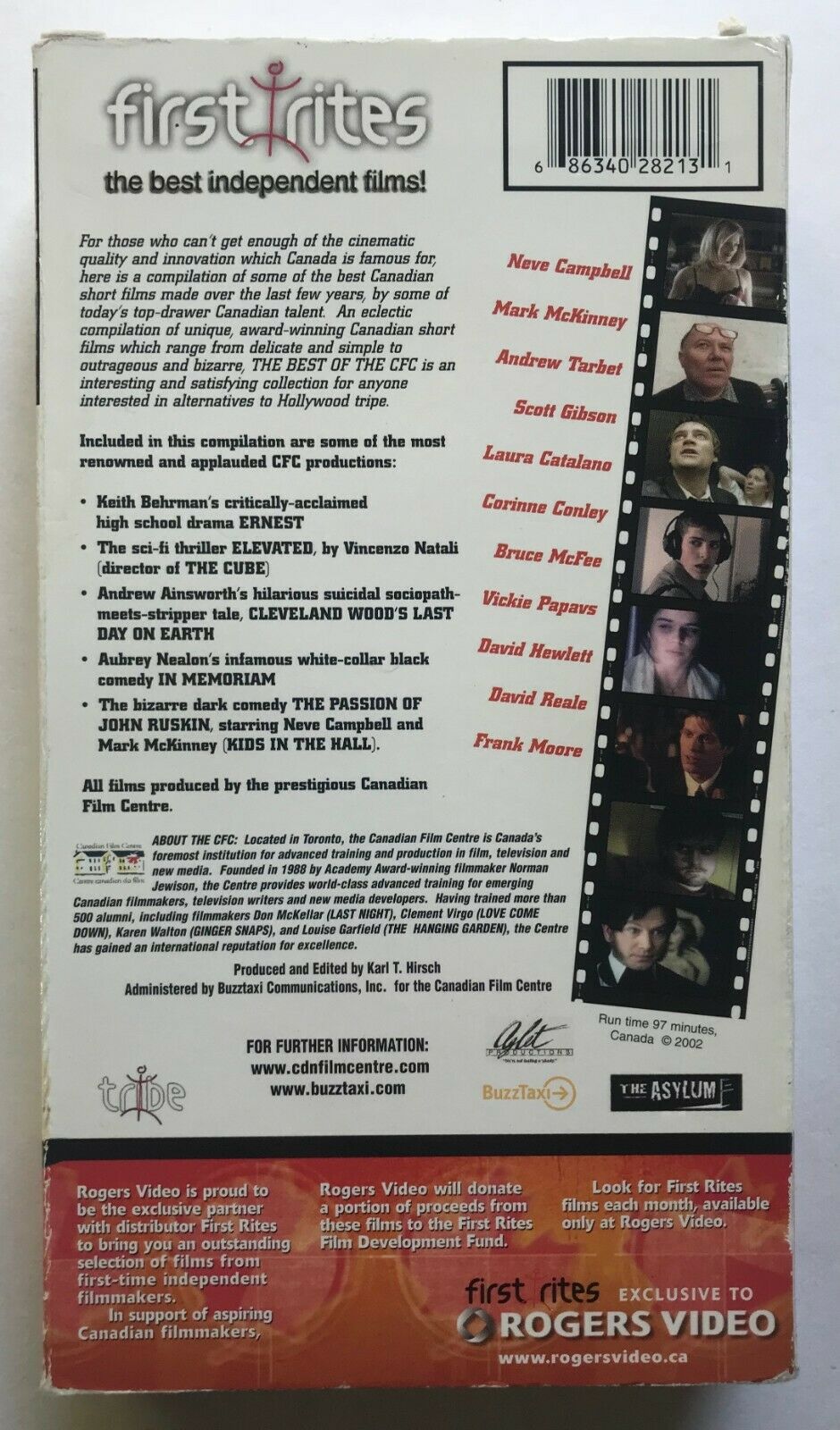
One thing about this Sabbatical- I've been getting caught up on household things I've either put off or didn't have time to do in my previous life. This week I was cleaning "the scary closet", and just in time for this week's VHS Mondays, I found this VHS tape. Vol. 1 The Best Of The CFC, is an offering by Rogers' First Rites label, which distributed Canadian-produced independent films (a redundant phrase, as most of Canada's cinema is independent). My past sojourns into video clearance bins and the like have turned up a couple of their releases (the Tarantino-influenced Troubleimmediately comes to mind), but otherwise I don't know much about this banner. A cursory Google search turns up little information, let alone how many titles it distributed, although our friends at Film Trap make a valiant first stab.
The Best Of The CFC (a Google search does not turn up a "Volume 2"), compiles five short films produced at the Canadian Film Centre, the institution for advanced film studies and production, founded by Norman Jewison in 1988. Featured are: Keith Behrman's Ernest (2002), Vincenzo Natali's Elevated (1996), Andrew Ainsworth's Cleveland Wood's Last Day On Earth (1996), Aubrey Nealon's In Memoriam (2001), and Alex Chapple's The Passion Of John Ruskin (1994). Re-discovering this tape is rather timely, because lately I've been thinking a lot about when I worked at the CFC while on field placement in college. There is enough material there for a couple of blog posts. Suffice it to say for now, I was there just before Andrew and Vincenzo made these films. I was supposed to have worked as a coordinator on these and the four other shorts that CFC produced at the beginning of 1996. Alas, they couldn't afford to pay me, and I couldn't afford to work free for another six weeks. So, there went my chance to have six professional credits on my resume. (Except for some positions, most of the crew members on CFC shorts were unpaid volunteers. Because of the mystique and prestige surrounding the CFC, and that these films potentially travel the world, these are added incentives for people to get up at 5 AM to lug Seeway pro bono.)
Among the alumni of CFC residents (writers, producers, directors) are such familiar names as Margot Kidder, Paul Quarrington, Mina Shum and Clement Virgo. Cynthia Dale, Scott Speedman and Sandra Oh are a few of the famous players who have appeared in their films. For some marquee value, the video box for this collection touts the names of Neve Campbell and Mark McKinney (both starring in John Ruskin), plus that of Vincenzo Natali, whose debut feature Cube was made by the CFC's Feature Film Project, just after his work on Elevated, to which this work is thematically similar.
Still, this got me thinking about how poorly Canadian film history is documented in some areas- especially for short films (that is, those not made by the NFB). You pretty much have to know what you're looking for, and even then, Google searches result in disappointingly little. One time I made a list of CFC titles I remembered checking film prints of in their projection booth, and pasted each of them into a web browser. For many, the returns were disappointingly minute. Additionally, I'd like for there to be a database of all titles that were distributed by First Rites. Hopefully, I can contribute some more HTML to the blogosphere in the near future. With each new generation, there is a cinematic heritage slipping through the cracks that needs to be upheld. Anyway, more on that in a future update. For now, time to pour a cup of coffee and revisit some memories.
What chromium dioxide delights await next week's column? Until then, be kind and rewind!
Because the pandemic has shuttered most theatres, many independent venues and film collectives had chosen to generate some revenue by streaming material online.
New York's fabled Anthology Film Archives turned to the internet to commemorate what would be their fiftieth anniversary of programming. Last month, for a limited engagement, they streamed an exact reproduction of their very first program decades ago, consisting of a few experimental shorts. And now for a limited time, you are able to view a Mike Kuchar short on their Vimeo account. His 30-minute Death Cult Of The Ju-Ju's (1976; pictured above) can be rented for $3.99 US to stream for a 72-hour period.
Synopsis from the AFA: "Arguably Mike’s solo magnum opus, DEATH QUEST is a mini-epic that gleefully and lovingly combines two of Mike’s favorite – if seemingly irreconcilable – genres. What appears at first to be a straightforward prehistoric tale soon morphs into something else entirely, with the deux ex machina appearance of…sorry, no spoilers. In any case, whatever the genre, DEATH QUEST was made with a nearly non-existent budget, but with admirably game actors, Mike’s uniquely resourceful visual gifts, and his inimitable ability to combine mischievous parody with wide-eyed sincerity."
Warren Sonbert's work warrants multiple viewings- all the more frustrating that one could only see it in various one-off venues. Gartenberg Media is changing that. We belatedly discovered that three of Sonbert's early works, all from 1966, Amphetamine (10 min), Where Did Our Love Go? (15 min) and his modern classic Hall Of Mirrors (7 min, pictured above), can be streamed for free until January 5.
From Gartenberg's webpage: "Sonbert’s earliest films, in which he captured the spirit of his generation, were inspired first by the university milieu and then by the denizens of the Warhol art scene, including superstars Rene Ricard and Gerard Malanga. In these loosely structured narratives, Sonbert boldly experimented with the relationship between filmmaker and protagonists through extensively choreographed hand-held camera movements within each shot. The mood of these films was further modulated by chiaroscuro effects, achieved primarily through natural lighting (in both indoor and outdoor shots), combined with variations in the raw film stock and the exposure and the use of rock-and-roll music on the soundtrack."
Visit this link here to view them while you still can. More of Sonbert's work will be made available by Gartenberg through 2021.
Joan Micklin Silver [May 24, 1935 - Dec. 31, 2020]
Writer-Director Joan Micklin Silver is one of my favourite filmmakers from the 1970s American Renaissance - a time when it was even more rare to see women making feature films. One could say that Ms. Silver (along with others in that small camp: Claudia Weill, Joan Darling, Martha Coolidge and Barbara Loden) was a trailblazer in that vein, as women had to make movies outside of "the system" (aka- The Hollywood Boys Club), and one could make the case that they still have to. But the term "trailblazer" is perhaps the incorrect term to describe the delicate beauty of her work. Rather, her films are of the subtle attributes that many works in "the system" still require: they are understated, unpretentious, disarmingly quirky, subtly surprising, and feel so organic, alive!
After directing some short films, including the well-regarded PBS short film, Bernice Bobs Her Hair, and co-writing the screenplay for Limbo (directed by Mark Robson), she made her feature-film debut with 1975's Hester Street, featuring Carol Kane in a breakthrough Oscar nominated role. My favourite of her work, 1977's Between The Lines, features an ensemble of now-familiar talent that was just on the cusp of breaking out (Jeff Goldblum, John Heard, Lindsay Crouse, Marilu Henner, Jill Eikenberry, and many others). Her subsequent film, the Bergman-esque Chilly Scenes Of Winter (1979), featuring Heard, Mary Beth Hurt and Gloria Grahame in one of her final roles, is a haunting fable of love gone wrong. The romantic comedy Crossing Delancey (1989), with Amy Irving, was a fine return to feature filmmaking, after spending a decade in television. (Many female directors found work in television after breakthrough features.) Her films were often produced by her husband, the late Raphael D. Silver. He directed one film, On The Yard, a 1978 prison drama also with Heard, which she in turn produced. The Silvers had three daughters: Dina, Marisa, and Claudia. Marisa also began a career of directing similarly subtle, affecting films: Old Enough (1984), and Permanent Record (1988).
FILMS: (as director, and screenwriter*, unless specified): The Immigrant Experience: The Long Long Journey (1972 short, +scr.),Limbo (1972; screenplay only, based on her novel), The Fur Coat Club (1973 short; +scr.), The Case of the Elevator Duck (1974 short; +scr.), Hester Street (1975; +scr.), The Frontier Experience (1975 short, screenplay only), Bernice Bobs Her Hair (1976 short; +scr.), Between the Lines (1977), On The Yard (1978; producer only) Chilly Scenes of Winter (aka- Head Over Heels) (1979; +scr.), Faerie Tale Theatre: The Nightingale (1983 TV short; screenplay only), How to Be a Perfect Person in Just Three Days (1983 TV movie), Finnegan Begin Again (1985 TV movie), Crossing Delancey (1988), Loverboy (1989), Prison Stories: Women on the Inside (1991 TV movie - segment 2), Big Girls Don't Cry... They Get Even (1992), A Private Matter (1992 TV movie), In the Presence of Mine Enemies (1997 TV movie), Invisible Child (1999 TV movie), A Fish in the Bathtub (1999), Charms for the Easy Life (2002 TV movie), Hunger Point (2003 TV movie)
Hester Street: Carol Kane
Between The Lines: Jeff Golblum
Between The Lines: Lindsay Crouse, Gwen Welles
Chilly Scenes Of Winter: John Heard, Mary Beth Hurt